Realty TV star lands on Vogue cover

By NICOLE LOPEZ-ALVAR

After months of speculation, the day is finally here—Kim Kardashian is on the cover of the reputable Vogue magazine.

Yes, it’s true. A notoriously famous reality star turned model and businesswoman is posing for the most famous fashion magazine of the 21st century.

The Internet has been in frenzy from posts ranging from the overly ecstatic to the mournfully dreadful.  This is due to the star’s not-so-common start in the entertainment business, and most likely, the fact that she is posing with her fiancé, Kanye West.

Due to the Internet, fans and “haters” are able to soak up Vogues April issue with the dynamic duo through multiple platforms. These range from Twitter announcements and posts about the spread, to an in-depth video of the making of the photo shoot.

An example of said media advertising started immediately with Kim’s Instagram post on Friday. She posted onto her Instagram account stating, “This is such a dream come true!!! Thank you @VogueMagazine for this cover! O M GGGGGG!!! I can’t even breath!” The post was linked to a photograph of the magazine cover, as well as the vogue.com article itself. No less than six hours later, the post has generated 547,495 “likes” and the numbers keep on rolling in.

These sources of excessive insight are the ingenious ways magazines like Vogue use social media to promote their stories instantaneously around the world. Therefore, for celebrities, such as Kim Kardashian and Kanye West, the hysteria on social media only makes the story surface more Web sites, more smart phones, and more bank accounts.

What makes this cover story relevant is the subtle hashtag underneath the caption of the photograph, which states “#worldsmosttalkedaboutcouple.” While this statement is a vast exaggeration, the hashtag serves two purposes — a clever nod to the fact that the couple’s Instagram followers combined ad up to 20 million, as well as a subtle advertisement for the social media sites that use such hashtags so people can follow the story and discuss it in an organized fashion.

Nowadays, through the use of social media, stars as hated as they are loved like Kim Kardashian, can cover more than one platform.

Overall, business models that incorporate social media are helping everyone involved generate more business and more income, while we sit here and continue to stalk the couple’s baby, North, on Kim’s Instagram page.


Did media cause school shooting hoax?

By TAYLOR HOFF

On Thursday, March 6, 2014, around 2:30 p.m., a call was made to 911 claiming that a student at Beverley Hills High School was being held hostage by a student gunman.

After the school — and surrounding schools — were placed on lockdown and, after much investigation, it was determined that the call was a hoax.

Is it possible that the media are to blame for this inappropriate prank?

After all of the recent school shootings, such as those at Sandy Hook, many precautions have been taken at schools around the world. In addition, media attention over such situations have thrived.

Due to the increase in media attention and the extra focus on safety in schools, students may now be seeking their own personal source of attention through these events.

Because of the hyped up nature of the crime, students see the potential for the magnitude of reporting these events.

Besides the hostage hoax at Beverley Hills High School, an anonymous bomb threat was reported through social media site, Yik Yak, at San Clemente High School. This, too, turned out to be a hoax.

With the feared epidemic of school shootings, comes a possible epidemic of reported fake shootings. With the rise in recognition of the topic, comes a bigger gain of attention for each reported crime. Students know that all threats and tips will be treated with the utmost importance and seriousness.

This developing popularity, may be increasing the amount of fake tips, which in turn, can lessen the validity of future reports.

Does God live in Hollywood?

By KELLY BRODY

The Oscars this past Sunday had it all: a pizza party, Meryl Streep and Pharell dancing, a record breaking selfie and, of course, many memorable acceptance speeches.

There was Jared Leto, whose heart-touching speech thanked his mom, acknowledged the tragedy in Venezuela and Ukraine, and was dedicated to the millions of people around the world with AIDs. Lupita Nyong’o made her speech all about following your dreams, saying, “When I look down at this golden statue, may it remind me and every little child that no matter where you’re from, your dreams are valid.” And of course, most every actor who accepted an award thanked their directors, fellow co-stars, and producers.

But this year, a common figure to thank in Oscar acceptance speeches was missing–God. It seems as though, in years past, the first person an award winner would thank would be God or Jesus. The only individual to mention God in their speech this year was the quintessential southern christian boy, Matthew McConaughey.

He did not just briefly mention God’s name either. McConaughey stated, “I want to thank God, because that’s who I look up to. He’s graced my life with opportunities that I know are not of my end or any other human end. He has shown me that it is a scientific fact that gratitude reciprocates. When you’ve got God, you’ve got a friend.”

Many people responded negatively to McConaughey’s religious devotion in his speech. Tweets like, “Shhh McConaughey stop talking about god you’re ruining it” (@astral_cars) and “When did Matthew McConaughey turn into Joel Osteen?” (@LaineyGossip) swirled about the “Twittersphere” during and after his speech. Even the audience in attendance did not respond too warmly to the God part of McConaughey’s speech, as there was timid applause in comparison to when McConaughey mentioned his dad in heaven and even quoted Dazed and Confused, McConaughey’s first major role, with “Alright, Alright Alright.”

Hollywood has always been seen as a more liberal land, with more libertarian views rather than the conservative. Strong religious views have been mocked and practicing religion is often seen as an ultra conservative activity in Hollywood, versus atheism or not practicing or declaring a religion at all. Hollywood is becoming very secular.

McConaughey’s breakaway from secularization and the negative response he received because of it is proof of the lessening presence of faith in our modern society. We treat those who are religious as the minority now, even “jesus freaks.” It’s just not “cool” or “hip” to be religious.

Maybe McConaughey, with his southern drawl, drug past, beautiful wife and shiny new award will change Hollywood’s perception of religion and mentioning God in a speech will draw actual applause rather than backlash.

Tweets about the reporting life in Sochi

By KERRIE HECKEL

Olympians’ performances aren’t the only things making news in Sochi.

A significant number of journalists have taken to Twitter to share with the problems they have run into while in Russia.

Perhaps it all started with the fifth Olympic ring not opening during opening ceremonies, but the Twitter handle @sochiproblems has collected a number of negative reports, mostly about hotel rooms, that can actually be quite comical.

Dallas Robinson, USA bobsledder, tweeted a picture of a door made out of cardboard which his teammate had torn apart and climbed through after being locked in the bathroom.

Steph Stricklen, news anchor for KGW in Portland, tweeted pictures of mirrored bathroom ceilings in Shayba Arena that reflected inside of the stalls to the neighboring areas. She captioned her photo, “because who doesn’t want to use a public restroom with completely mirrored ceilings? thanks shayba arena!” Sporting a grimacing look on her face in the reflection of the ceiling.

My personal favorite tweet was by author, screenwriter and sports columnist Dan Wetzle from inside his hotel room. The tweet is a picture of three light bulbs that reads, “To anyone in Sochi: I am now in possession of three light bulbs. Will trade for a door handle. This offer is real.” Maybe he could help out ESPN reporter Marc Connolly who tweeted a picture of a lamp with two missing light bulbs saying “Only one light bulb per lamp apparently”.

Still, while many reporters seem to be looking at problems in Sochi light-heartedly some issues they have run into is no laughing matter.

One of those issues has to do with the quality of water. Stacy St. Clair, a reporter for the Chicago Tribune, reported that employees at her hotel told her not to put the water on her face as it had something very dangerous in it. The water she pictured on Twitter was a yellow-brown color that I cannot imagine she wanted to put on her face anyway

St. Clair later tweeted, “Also on the bright side: I just washed my face with Evian, like I’m a Kardashian or something.”

Other reporters tweeted pictures of open electrical units and light fixtures falling from the ceiling.

The brutally honest tweets continue to roll in but if you’re putting a group of journalists in hotels with less than stellar accommodations what else can you expect?

What I’ve gotten out of these tweets @sochiproblems, other than some good laughs, is that good journalists report stories when they see them, not just when they are assigned. Sure these reporters were there for the Olympics; but they saw something noteworthy of sharing and they did. Although it might be simple these reporter show that being a journalist isn’t your typical 9-5 job, it’s a lifestyle that continues even when you’re off the clock in your relaxing hotel room.

Team USA unites a nation

By RYAN HENSELER

At high noon tomorrow in Sochi, Team USA will battle Canada in men’s hockey with a spot in the gold medal game on the line. The game is a rematch of the final of the 2010 Vancouver Olympics, which Canada won in overtime.

The U.S. is riding high following an epic win against Russia in the group stage, in which TJ Oshie became a cult hero by scoring four shootout goals to propel the Americans to a 3-2 victory. The win has been widely considered the greatest U.S. hockey win since the 1980 Miracle on Ice.

The Olympics are famous for promoting national unity and no Winter Olympics event accomplishes this goal better than hockey. Since the Olympics have begun, shirts bearing the USA emblem have been a common sight across campus.

The Twitterverse also exploded following the victory against Russia, with hashtags like #Oshie trending throughout the day. Viral videos also surfaced of raucous celebrations of the game-winning goal from bars around the country, mostly attributed to the popular blog Bartsoolsports.com.

The excitement leading up to the face-off versus Canada has been almost tangible among sports fans across the country. In a way, that is the true magic of the Olympics. Once every two years, everyone in the U.S., though fans of many different sports teams, can unite under one common goal.

For once, Yankees and Red Sox, Celtics and Lakers, Duke and North Carolina’s fans can all cheer for the same team. Go USA!

Future of news … Is it in our hands?

By PHOEBE FITZ

As newspaper circulation drops, more and more people are turning for the Internet for their news.

Online subscriptions to newspapers such as The New York Times and the Wall Street Journal are on the rise, but online papers aren’t the only place news-hungry people are turning to for their information.

Blogs, Twitter and Facebook are increasingly turned to for updates on the current state of affairs. With approximately 87 million tumblr blogs, one billion active monthly Facebook users and Twitter’s 20 million users that send almost 400 million tweets per day, it is abundantly clear how social media is transmitting news and information.

Many actual journalists use these tweets and Facebook updates in their stories as information, which can potentially lead to misinformation since these sources are not fact-checked and could possibly be unreliable. But, they could also be spot-on and a great asset.

The rise of social media has led to a rise of self-created journalists and journalist assistants, if you will.

The news isn’t in our hands now, but right at our fingertips.

Ugandan president signs anti-gay bill

By JENNA JOHNSON

Last week was full of proud declarations of homosexuality from prominent names and an overall positive reception from the media and society.

Early in the week, University of Missouri football lineman and potential top draft for the NFL, Michael Sam, established himself as the first openly gay player to be drafted into the NFL.

Citing Michael Sam as a “hero,” Actress Ellen Page came out as a lesbian on Valentine’s Day during a speech she gave in Las Vegas.

Both celebrities have received much support from fans and LGBT organizations such as the Human Rights Campaign. Social media exploded with congratulations and encouragement.

Screen Shot 2014-02-18 at 11.31.36 AM

Meanwhile, on the other side of the world, Ugandan President Yoweri Museveni signed a bill prohibiting homosexuality.

Homosexuality is already illegal in 78 countries around the world, including much of Africa and the Middle East. Seven of these countries punish homosexuality by the death penalty. In Uganda, homosexual acts are punishable by 14 years in prison. Even organizations or individuals who reach out to counsel homosexual persons can face imprisonment.

President Museveni said he was persuaded to sign the bill, not out of political, but scientific, motivations. He claimed legalizing homosexuality poses “serious public health consequences” according to his scientific advisers.

Musevini’s advisers also assert that homosexuality is an “abnormal behavior” and not something a person is born with.

In the United States, the controversy of gay marriage legalization is always in the news media. It seems to be the “will-they, won’t they” issue of the century.

Whether or not same-sex marriage is legalized in our country, maybe it’s time to pause and enjoy the freedom of expression guaranteed to us by the Constitution.

Despite overwhelming support from the LGBT community, both Page and Sam undoubtedly received a backlash from certain anti-gay groups. Unfortunate though this is, at least they never have to face imprisonment, violence, or unemployment that the few openly gay Africans struggle against.

In my opinion, how a country reacts to the homosexual community demonstrates its degree of progressiveness. The support for LGBT causes is increasing in the United States today, especially with the younger generations. Although the gay marriage controversy remains murky, almost any American would at the very least agree with a person’s individual right to be gay.

Personal opinions aside, from a legal standpoint, Americans uphold all anti-discrimination rights. The matter of whether homosexuality is a choice does not even apply, because everyone is guaranteed the right to express him or herself.

President Obama said that if Uganda’s president passes the anti-gay bill, it will complicate relations with the east African nation. President Museveni decided to push through with the law, opting to uphold the country’s “morals” despite losing international allies.

How “moral” is it to alienate, penalize,and even torture a citizen for how he/she chooses to express love?

Uganda’s government’s behavior demonstrates unacceptable treatment of not just to the gay community, but any group. When this kind of expression is severely punished, it becomes an issue of human rights and dignity.

It’s too soon to tell how relations with Kenya will pan out after the bill passes. However, it seems from the outcry of international responses that most of the world is ready to defend the homosexual community and freedom of expression.

Is journalism still important?

By REBECCA FERNANDEZ

With news media changing faster than you can tweet, Tumble or post about it … it is hard to weigh the importance of journalism in this Digital Age.

Print journalism is going through a difficult time: facing deaths of newspapers and media outlets. Is journalism at risk as well?

Many people ask: “What is it that journalists actually do? How do we define a journalist? How is a journalist different than a blogger?” Traditionally, journalists go to the scene themselves and write, narrate, or shoot what is happening. They investigate and publish stories.

In our modern Digital Age, journalists have the ability to do more with the power of technology. We really had a hands-on experience in this through the Scavenger Hunt project in our CNJ 208 reporting class. They filter the clatter of the Internet by gathering all of the relevant articles in one story. They use these powerful new ways of communication to bring attention to important issues, whether they reported first or not. They live-blog and retweet the revolutions by introducing raw facts.

There is a need for professional journalists, not because they know how to write, but because they follow the rules and journalistic ethics, and they are competent about many topics they report on.

Journalism is still relevant, but it has definitely changed.

Tweets may cause cancellation of trip

By REBECCA FERNANDEZ

Plans for students at Ohio University’s journalism school to travel with the United States Soccer Team to Brazil for the 2014 World Cup, writing for and about the team, may come undone thanks to the students’ tenacity.

On Monday, students in the E.W. Scripps School of Journalism learned of the trip and a lot of them tweeted about it. On Wednesday, several students contacted the U.S. Soccer Federation to start asking questions. And now, the U.S. Soccer Federation is thinking otherwise.

The program seemed a sure thing on Monday when the school held a press conference announcing the team-school partnership.

“It is still in the works, actually. There has been a lot of excitement from our students,” said Associate Professor and Institute for International Journalism Director Yusuf Kalyango.

But nothing is yet confirmed, he said, and the whole thing could fall through.

Journalism students being journalism students ran with the story and contacted the federation for details, resulting in bad news of “it may not happen now.”

Kalyango did hold the press conference with journalism students, but he didn’t expect them, or the journalism school, to then report on it. But they did.

For more information, see http://www.ohio.edu/scrippscollege/news-story.cfm?newsItem=6ED0AB31-5056-A81E-8D34D5FE7D34FB12.

Twitter hires first head of news

By SHAI FOX SAVARIAU

Twitter just made a big move by hiring Vivian Schiller, NBC News’ chief digital officer, as its first head of news and journalism partnerships. She also has had prior experience at CNN, The New York Times, and National Public Radio.

Schiller will be the person who connects Twitter to prominent news organizations. Twitter executives have been saying for months that they want to help media companies distribute news and now they have the right person for the job.

It is also said that she was hired due to the fact that there have been complaints about Twitter’s Board of Directors being mostly made up of white men. Her hiring adds diversity to the company.

Twitter has been hiring a number of prominent people to be heads of other departments like music and sports.

I get the feeling that this is just another step towards social media taking over journalism. A head of news and journalism partnerships at a social media company is already very different from how social media have been operating in the past, not to mention the fact that high profile people, like Schiller, are leaving their high profile jobs, like at NBC, to work there.

I also feel that this is a strategy for Twitter to be on top of all other social media sites. If Twitter is hiring people to make stronger relations with other companies, then that means it will have the support from multiple diverse organizations.

Journalism is a important part of society, and if Twitter is taking that leap to make it a prominent part of their site, then it will be more widely used by people.

Should we use Twitter for our news?

By VALERIA VIERA

Twitter is an interesting form of information source. According to the article, “The Twitter Explosion,” by Paul Farhi, “it all depends” on whether Twitter can be a useful news tool or not.

Why? Unknown

Because sometimes it is fast, newsworthy, and reachable for millions of people. But sometimes, it gives incorrect information, for example, immediately after the Boston Marathon terrorist bombing attack. Sometimes it can even give false information so damaging that it can actually destroy a person’s life.

Like the article says, Twitter is a “free social networking service that enables anyone to post pithy messages, known as tweets, to groups of self-designated followers. The tweets can be sent from and received by any kind of device — desktop, laptop, BlackBerry, cellphone.”

This is practical in one way but, in another, it also means that many people not only have fast access to the information, but also to the posting of it, even if sometimes what they post is not true. The problem with this service functioning as a news source is the fact that so many people use it nowadays and but some do not have the best intentions. 

Why is Twitter different from other sources? Because it is a type of media which is utilized not only for breaking news, but for many sorts of things such as giving news about events, stores, sports, and of course for individuals who want to share their own thoughts. Anyone can post and its content is neither filtered nor edited by professional journalists.

Twitter is capable of creating conversations between different sources, provides the ability to comment, as well as the opportunity to “retweet” someone else’s posts. WIth all of these possibilities, it is easy for a rumor to be formed and rapidly be delivered to millions of people around the world.

News reporters use Twitter from any event and ‘tweet’ what is going on around them.

“Twitter can be a serious aid in reporting. Reporters now routinely tweet from all kinds of events — speeches, meetings and conferences, sports events,” said Farhi, which I believe is true but, for that same reason, people should always make sure that what they are reading is true and that it has enough evidence to support the written facts.

Crossing the line when posting

By SHAI FOX SAVARIAU

The National Rifle Association is attempting to get a journalism professor dismissed for tweeting that the navy yard shooting was their fault.

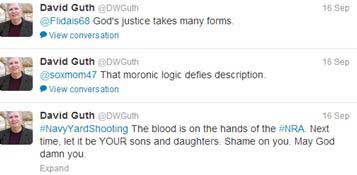
David Guth, a professor at the University of Kansas, tweeted “#NavyYardShooting The blood is on the hands of the NRA. Next time, let it be YOUR sons and daughters. Shame on you. May God damn you.”

David Guth's tweets after the Navy Yard Shooting.

David Guth’s tweets after the Navy Yard shooting (Screen capture by Shai Fox Savariau).

Kansas State Rifle Association’s President Patricia Stoneking said that Guth should not be allowed to teach.

Stoneking said “The KSRA will do everything possible to see to the removal of this man. He should be fired immediately. His statements are outrageous,”

“Any person with such a vile and contemptuous attitude who has influence over our children as a professor does should be immediately fired.”

Officials at the University said that Guth’s tweets do not reflect the views of the university.

In later blog posts, Guth wrote that he did not regret writing these things and that he is prepared to be criticized by others.

I don’t fully agree with how Guth expressed his feelings via Twitter. I am a strong advocate of freedom of speech, but speaking out about how the NRA’s sons and daughters should be hurt next time there is a mass shooting is not the way to get your point across.

As a journalism professor, I believe Guth does have a duty of showing that he can express his opinion in a way that’s not attacking another group of people. Speaking out and inciting violence on the Internet, which is not a private place, is not the civil way of expressing yourself.

I think that as journalists, we have to carry ourselves in a certain way. A big thing for a journalist is to report news without including bias. Yes, Guth’s tweets and other blog posts were just him expressing himself about the navy yard shooting. But, he could have written his distaste for the NRA in a way that wasn’t so gruesome, in my opinion. Even outside of work, Guth has that duty to carry himself with poise towards any breaking news situation. Even on the Internet.

Guth is also a professor at a university. Being that I am a college student myself in a journalism program, I can relate to this situation. I would not appreciate knowing that a professor of mine was writing such harsh things on the Internet.

Teachers of any kind need to be very careful of what they post on any type of social media. It can be seen by anyone and since teachers are responsible for the shaping of younger minds, it is important that they don’t encourage these types of violent responses from their students, especially journalism students.

Guth’s students will be on a job hunt very soon and if they are exhibiting the type of behavior that he showed on Twitter, then it may be a challenge for them to find a position.

Social media can be a very powerful tool but it must be used in a way that won’t offend others.

Original article can be found here: http://www.kctv5.com/story/23480333/ku-journalism-professor-underfire-for-nra-related-tweets-after-navy-shootings.