What Francis says, what media perceives

By DANIELLE COHEN

Decades of popes have consistently been well spoken and have paid special attention on emphasizing the pastoral care of the Catholic Church. The current church leader, Pope Francis, does not differ from previous popes in his way off addressing his people. He is careful and has a very selective choice of words.

What the pope says is not always perceived the way it is meant to be by journalists and is released into the press with false statements that the pope did not actually say or mean.

Former Cardinal Jorge Bergoglio picked his words carefully as an Argentine priest and then prelate of Buenos Aires. He was impeccable in his word choice, especially with the politics that attacked Argentina for many years.

Journalists are very interested in what the pope has to say, knowing it could potentially make international headlines. With this, the problem of journalists misunderstanding and misdirecting the media was noticed last spring after Pope Francis’s installation. There was a report in USA Today, for example, about the pontiff’s supposed “obsession with Satan,” of which many Protestants, Catholics and other Bible readers were skeptical.

The newspaper stated that the pope “mentioned the devil on a handful of occasions.” The reporter took an incident where Pope Francis gave a blessing to a handicapped man and speculated the idea the Jesuit pontiff was an exorcist, or from the film “The Exorcist.” The Vatican then went further to tell the international press that no priest performs “ad hoc exorcisms” and the popes usually pray with and bless’ victims.

Any reporter covering this story could have flipped through canon law, the Bible or Catholic catechism, which are available to the public.

A couple of days later, reports came out that Francis declared that atheists would go to heaven as long as they did good deeds. The media took his words out of context when really Francis spoke of “ecumenical communion between believers and good-hearted atheists.” Nothing Francis said had contradicted the belief that work for the poor and downtrodden people would provide a meeting place in people’s hearts.

Two months following this false media report, the media then again reported something out of context. They claimed that Francis declared that the church would no longer “judge” homosexuality. What he actually said was “Who am I to judge” in response to a question about the “gay lobby” and focused on “lobbies” of all kinds focused on the segment of society destroying Christian unity and brotherhood.

Last week, a lengthy interview with American Magazine took place with Francis, which was published by and for the Jesuit Society in America. What the media got from this interview was that the pope was going to change the doctrine — or at least soften it up a lot.

ABC then went on to report this as the pope scolding the Catholic Church over “divisive rules.” A European wire service reported that the “pope seeks easing of rigid Catholic doctrine,” which references other media sources that states he was “pushing a shift” in the Catholic Church. The abortion rights group, NARAL, went on with this false information and published a thank-you note to the pope, only to find him excoriate abortion a few days after.

Continued media failure upsets Catholics who truly understand Francis’s true message. This brings up the question of media credibility on religious matters and even more broadly than that. Catholic documents are easily obtainable and yet the media doesn’t appear to be checking facts before publishing news stories that change the words of Francis and the Catholic Church.

To read more: http://theweek.com/article/index/250062/the-medias-mind-boggling-failure-to-understand-pope-francis.
Be a reporter, be a friend, or be both?

Posted September 24, 2013

By REBECCA FERNANDEZ

Last Saturday, Sept. 21, reporter Jason Straziuso had to choose what was more important to him … being a friend or being a reporter.

Jason Straziuso was in Nairobi, Kenya, when he got a frantic phone call from a close friend that was staying the weekend with his family. She was inside Nairobi’s most upscale mall and could hear gunshots. Her husband and 2-year-old daughter were inside, too, but she didn’t know where. Where should she go?

“Over the next several hours, my role as a reporter collided with my concern for close friends in mortal danger,” said Straziuso.

Reporters must separate their emotions from scenes of horror, but that’s a near-impossible task when your friends are facing attackers lobbing grenades and firing bullets.

At first, his friend, Lyndsay, had no idea what was going on, but as soon as he rushed over to the mall, he realized that everyone there was under attack by al-Shabab terrorists.

Lyndsay’s husband, Nick, was with their daughter, Julia, in the downstairs cafe that appeared to be the initial attack point. He scooped up his toddler and ran. They ended up being pushed into a department store storage area and would stay there the next three hours.

“Lyndsay was in a third-floor movie theater when she called me again. If gunmen found her and others, there was no escape, she told me,” said Straziuso.

After Straziuso told the police everything he knew about what was going on inside the mall, he returned to his own work as a reporter. Suppressing his fears that his friends could be killed. He snapped photos, took video, and interviewed a Dutch couple who had been close to the grenade blast.

About an hour later, Straziuso got a call from Lyndsay that she was on the roof and he got some police officers to help her and the roof hostages escape, but husband Nick and daughter Julia were still inside. Eventually, police offers were able to help more hostages escape, Nick and Julia being two of them.

“We were so scared,” Nick said later,”I was just finding any way I could to get out.”

Fortunately, Straziuso was able to help out his friends and, at the same time, get his job done as a reporter. He was so thankful that he was able to accomplish both.
As a reporter, he knew that not everyone’s day ended so well.

Grand Theft Auto is a media rockstar

By ADAM HENDEL

Journalists, and some social media users fear the impact of the new Grand Theft Auto V’s video gaming experience upon other people, particularly the youth.  However, talk about the violence, vulgarity and mature content does not scare the consumers away, it seems to promote interest.

Grand Theft Auto V was released Sept. 17 and the game has generated more sales than any game in history and with such controversial subject matter, it’s no wonder why this game is all over social media.  The game raked in a shocking $800 million its first day according to Take Two Interactive, who is the primary developer and publisher of Rockstar Games.

With 200,000 Facebook users chatting about the game at one time, it is apparent that social media is to credit for putting the game in the spotlight. Even with the knocking of the game, all attention becomes beneficial for the sales of the game.

TMZ’s Facebook page posted the article to Facebook pertaining to a boycott of the game. However, the dispute is not related to the gang promotion or gun violence, it is a protest by animal activists saying Rockstar Games is “capitalizing off animal torture.”

Jack Carone, from In Defense of Animals said, “the makers of this game have traded decency for money” and added “Encouraging the darkest impulses of young people is not an admirable pursuit.”

Perhaps the game is not suited for children, but the aspect of animal violence in the game is not the promotion of our youth’s “darkest impulses.” Practically all responses to the boycott post were bashing the animal activists for being overly sensitive.

Some responses just state how it is simply a video game, but the best argument is from fans like Paul Nweke who questioned, “it’s okay to kill human beings in a video game, but it’s not with animals?” In terms of fighting a multi billion-dollar project, picking this battle will not stop many from buying the game.

Fans feel strongly about the game and all the disputes about it only raise more interest for those who have not experienced the game yet. By way of social media, the game is promoting itself by giving the people such interesting topics to debate. It is a juicy subject, which is what our social media world thrives upon.

When will NBA stay out of Its own way?

By MATIAS WODNER

There are rumblings that the National Basketball Association is trying to have NBA players from the Miami Heat and the Brooklyn Nets wear jerseys with their preferred nicknames on the back of their jerseys.

I am not making this up.

Instead of the traditional way, in which every single player has his last name on the back of the jersey, players will be able to choose which nicknames they want on their jerseys. For instance, LeBron James will most likely use “King James” or “LeBron.” Ray Allen might use “Jesus Shuttlesworth,” a character he played in the hit movie “He Got Game.”

“”Fans will like it and so will a lot of the players,” Allen said. ”Guys will get a good kick out of it.”

Though Allen and a couple of other players might like the idea, I’m not jumping on the bandwagon. Neither is Heat forward Shane Battier, although he’ll obviously comply with the league should it happen.

The NBA just loves the attention, because with it comes, of course, the money. But this is as cheesy as anything any major sports league has done. And it isn’t the first time that the NBA is making headline news for something they shouldn’t be doing.

In 2011, all-star point guard Chris Paul was traded from the New Orleans Hornets to the Los Angeles Lakers. But Commissioner David Stern vetoed the trade, stating the trade was not in the best interest of the Hornets and of the league. He cited “basketball reasons” as his rationale. Paul was subsequently traded to the Los Angeles Clippers in a trade that the NBA didn’t deem too bad for them.

It’s always about them and this latest publicity stunt shows their selfishness and a lack of professionalism.

For more on this story, click here.

Blackberry struggles to keep up

By AXEL TURCIOS

Is anybody buying Blackberries anymore? Are there any new models coming out soon? Why is it is hard to see them around?

Well, I believe that those are questions that everybody wants to find the right answer.  However, in reality it is true that the phone maker is going through a hard moment in its history.

“It’s just too good to only keep it to us,” Thorsten Heins, Blackberry CEO, said of its once famous messenger service BBM.

The mobile company’s decision to release its messenger app to other mobile platforms looks to many like a strategy to save the company from an expected bankruptcy.  The service features BBM Chat for instant messaging with other users. Additionally, each user has a unique PIN, so you don’t have to give out your phone number to use the service mostly a privacy feature.

I think this should be something positive for the phone maker that seems to be struggling to bring revenue to its stock share.

The Canadian company that once was at the top of the list of the most-sold mobile devices in the United States, announced this week that they would eliminate of 4,500 positions.  In other words, that means 40 percent of its current work force.

In fact, things like these seem to predict the end of the Blackberry era.

Many experts believe that the company’s biggest loss comes from phones that were not sold because of competition from other smartphones, such as the iPhone, in the last couple of years.

A little bit more than four years ago, Blackberry controlled 51 percent of the mobile global market. Today it stands at three percent.

When the iPhone came out, cell phone history changed.  Apple released a new device that revolutionized the way many people talk to each other. It created a touch screen smartphone that was capable of running a variety of apps.

Alongside the iPhone came the Android operating system that rapidly became iPhone’s biggest competition.

Are Blackberry’s final hours are here? Will the company be able to rise from this fall?  Well, we don’t know those answers yet but if it does fall or rise, it’ll certainly be a top story.

Media fuel craze over new iPhones

By ALEXANDRA SILVER

The IPhone 5s came out this past week, but that is old news to most college students around the United States and the world.

The craze for Apple technology is still going strong as people stand in lines for hours to get their hands on the newest IPhone, IPad and MacBook.

It is hard to believe that a major headline this week was titled “Gold IPhone 5s won’t ship until October.” This begs the question; is this truly newsworthy? Or have we gone overboard with our obsession of material objects.

That wasn’t the only surprising article floating around the Internet about IPhones. Other headlines and articles read ‘Can IPhone addiction wreck your marriage?’ and ‘Psychologists Concerned about IPhone Obsession.’

The new IPhone 5s is said to have an application that disables the possibility of anyone other than the owner of said phone to unlock the lock screen. This new addition may discourage others who may try to steal these IPhones and sell them, as it is said to be nearly impossible to hack into these new devices.

Although, in a matter of minutes, multiple articles and videos surfaced online with tutorials that taught the art of hacking into this new IPhone 5s making the application useless.

Students have already taken to Twitter and Facebook with information about the new IPhone along with iOS7, which is newest operating system for Apple cell phone and tablet products. Many complain about the new look, despite waiting long hours on line and spending a decent about of money.

In only 10 minutes, the shipping date for this new gadget went from two business days; to 10 and this back order issue will continue for quite some time as it has in the past.

With this new information floating around the media, we have to consider that all new technologies are usually flawed and the small differences such as an anti-hacking application or a gold colored IPhone are not necessarily worth the anticipation and money.

Genuine human interaction is becoming a thing of the past due to the obsession with social media and networking that these phones allow one to have at all times. Whether it is through Facebook, Twitter, Tumblr or simply texting, the need to be connected at all times is proving to be a serious issue.

Crossing the line when posting

By SHAI FOX SAVARIAU

The National Rifle Association is attempting to get a journalism professor dismissed for tweeting that the navy yard shooting was their fault.

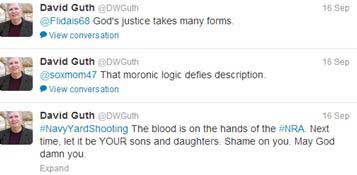
David Guth, a professor at the University of Kansas, tweeted “#NavyYardShooting The blood is on the hands of the NRA. Next time, let it be YOUR sons and daughters. Shame on you. May God damn you.”

David Guth's tweets after the Navy Yard Shooting.

David Guth’s tweets after the Navy Yard shooting (Screen capture by Shai Fox Savariau).

Kansas State Rifle Association’s President Patricia Stoneking said that Guth should not be allowed to teach.

Stoneking said “The KSRA will do everything possible to see to the removal of this man. He should be fired immediately. His statements are outrageous,”

“Any person with such a vile and contemptuous attitude who has influence over our children as a professor does should be immediately fired.”

Officials at the University said that Guth’s tweets do not reflect the views of the university.

In later blog posts, Guth wrote that he did not regret writing these things and that he is prepared to be criticized by others.

I don’t fully agree with how Guth expressed his feelings via Twitter. I am a strong advocate of freedom of speech, but speaking out about how the NRA’s sons and daughters should be hurt next time there is a mass shooting is not the way to get your point across.

As a journalism professor, I believe Guth does have a duty of showing that he can express his opinion in a way that’s not attacking another group of people. Speaking out and inciting violence on the Internet, which is not a private place, is not the civil way of expressing yourself.

I think that as journalists, we have to carry ourselves in a certain way. A big thing for a journalist is to report news without including bias. Yes, Guth’s tweets and other blog posts were just him expressing himself about the navy yard shooting. But, he could have written his distaste for the NRA in a way that wasn’t so gruesome, in my opinion. Even outside of work, Guth has that duty to carry himself with poise towards any breaking news situation. Even on the Internet.

Guth is also a professor at a university. Being that I am a college student myself in a journalism program, I can relate to this situation. I would not appreciate knowing that a professor of mine was writing such harsh things on the Internet.

Teachers of any kind need to be very careful of what they post on any type of social media. It can be seen by anyone and since teachers are responsible for the shaping of younger minds, it is important that they don’t encourage these types of violent responses from their students, especially journalism students.

Guth’s students will be on a job hunt very soon and if they are exhibiting the type of behavior that he showed on Twitter, then it may be a challenge for them to find a position.

Social media can be a very powerful tool but it must be used in a way that won’t offend others.

Original article can be found here: http://www.kctv5.com/story/23480333/ku-journalism-professor-underfire-for-nra-related-tweets-after-navy-shootings.

With fame, comes loss of privacy

By REBECCA COHEN

Innocently walking down the streets of New York, actress Nicole Kidman was knocked to the ground by a paparazzo on wheels last week, according to the Associated Press. The actress was reportedly shaken but is now ‘OK.’

However, Nicole Kidman isn’t as innocent as she seems in this situation by walking down a public street in New York City, the ultimate site to be spotted. Although she was not deserving of the danger that occurred, she could not have rightly thought that such a scene would not ensue.

Theoretically, Kidman signed up for this kind of attention in 1983, the year she starred in her first film. Upon signing that first contract, she signed away a chunk of her privacy rights to the media, because fame comes only after giving up a certain level of privacy.

After all, would an actress really be a celebrity if she were solely known for her on-screen performance?

If America doesn’t know who they’re dating, what diet they’re on, and what brand they are wearing, they are just an actor – not a celebrity.

Perhaps that is the very thing that makes reality television so interesting.

Do you know what Jonathan Groff has been up to lately? That’s because he is an actor, not a celebrity. He is a Tony award nominee and has starred on Broadway and hit TV show “Glee.”

Although he is arguably more talented than, say Jennifer Anniston, for the time being, he refuses to hand over his confidentiality. America doesn’t know him and therefore, he lives freely to walk down the streets of New York without fear of stampede.

Groff would not be the star of a news story but Anniston is all over the place. We know her every move, because she’s a celebrity and not just an actress.

Whether she’s Nicole Kidman or Jenifer Anniston, these starlets knew what they were signing up for upon signing away their right to privacy and simultaneously gaining a ticket to fame.

The dreaded knock

By MELANIE MARTINEZ

When covering a story, it is almost always necessary for a reporter to conduct interviews. These interviews are for experts, witnesses or any other person involved. It doesn’t take much, since most people like to talk and relate their knowledge or experiences. And for the reporter, he or she gets to meet people, gain insight, and learn new things.

But what happens when the story involves a mass shooting? And the people you have to interview are the friends and families of the victims?

In light of the recent Washington Navy Yard shooting, this issue comes to the surface.

I came across an article in the Huffington Post aptly named “The Worst Work of Journalism.” It delves into this topic, and explains how uncomfortable and devastating it is to be sent to cover stories of mass shootings and murder, charged with the task of interviewing the loved ones left behind the disasters.

In the article, its author Brian Rooney explains how as a journalist, he has had the unfortunate job of having to interview the family and friends of people who have passed.

He explains that when the injustice of murder occurs, the victims must be humanized. They must have faces, histories, voices and people who loved them in order for others to truly see the horror of a taken life.

This requires the miserable task of getting information from the loved ones of the victims. No reporter wants to be sent to cover a story where they’ll have to knock on the victim’s door, that dreaded knock.

Rooney describes the people who are open and friendly and give a lot of information. He recounts the story of a time he interviewed the boyfriend of a girl who had just been shot in the head by an ex-paramour. The boyfriend spoke of his girlfriend affectionately as he cleaned her brains out of a cookie jar.

Rooney also describes the people who don’t want to talk at all, and the dilemma of being told by your boss you must get the interview even after repeated declines.

Every reporter, like Rooney says, hopes that when they knock on the doors of the families  and stand outside the church services that it’ll be the last time. That society will see how horrible these massacres are. That things will change. All we can do is hope for no more dreaded knocks.

To read the full article, visit:

http://www.huffingtonpost.com/brian-rooney/the-worst-work-of-journalism_b_3943447.html


What happened to real news?

By MARISSA YOUNG

Yesterday, I attended a presentation by Alina Falcon, Telemundo’s executive vice president of News and Alternative Programming, in the School of Communication. She spoke about the changing role of the media, and one comment particularly struck me. She said that today, there is increasingly less unscripted, serious news; it is being replaced with straight talk, interviews, and other filler that costs less to produce.

Falcon’s remark resonated with me because, when I watch news programs, I feel uncomfortable during certain segments that can’t really be classified as news.

Though whether entertainment news is news is a controversial topic among journalists, that’s not close to what I mean.  I’m not saying that entertainment stories shouldn’t be on the news.  Some people really are interested in celebrities, TV shows, and the like. At least these stories deliver information to which the average person isn’t already privy. But news programs often take this too far, as in shamelessly plugging their own networks’ shows.  You’ll find stories raving about the “must-see” season of The Voice (does anybody even watch this, anyway?) on NBC, but the show isn’t so much as mentioned on ABC or CBS.

Then there are the stories that can’t be labeled “newsworthy” by any standard.  The kind entitled “Six Places You May Have Misplaced Your Keys” or “Eight Things You Shouldn’t Say to Strangers.”  These types of stories have literally no new or valuable information.  I mean, if a cameraman from the news station came up to me right now, I could cover the same story off the top of my head.

The best is when the programs show you teasers from upcoming stories. “What was the unbelievable item a student found in her lunch?”  “Coming up: You’ll never believe what happens in this video!”  “Stay tuned for the shock a mother got when she opened her front door!”

You wait a half hour to find out.  Sometimes, the story really is surprising, like if the girl found a diamond ring in her sandwich. Still, it’s cruel that programs leave you hanging for so long to hear about it. Other times, the content is just short of being as engaging as a black screen: the video is of a guy failing to balance on one foot, or the mother was checking her mail until she realized it was Sunday.

This kind of programming is embarrassing to watch, and should be infinitely more embarrassing to air. I challenge networks to spend some money and give us real news or to remove this façade by at least transferring these filler clips to differently categorized programs.  Otherwise, networks would be better off showing sitcom reruns during the time slots these stories waste.

Where modern journalism stands …

By VALERIA VIERA

Media is the new term we now use instead of press, said media critic Jay Rosen in his article “An Introduction,” explaining that the term is more of a “modern, abstract, inclusive, elastic, and of course more commercial” term.

Through this article Prof. Rosen tries to persuade readers that was he’s saying is true. He says “we need to keep the press from being absorbed into The Media.” This caught my attention because technology is definitely taking over and each day that goes by the Internet is more and more part of our lives.

The news we once had to sit and watch, or read in newspapers, are now available instantly in our computers, smartphones, or other portable devices.

This article, as a whole, is a way of saying we shouldn’t make that mistake of leaving press behind, since historically it’s what started it all, and for him the best “backward glancing term.”

Rosen defines it at the end as “Ghost of democracy in the media machine” and I believe it is the perfect way of expressing that press must not be forgotten and must always have a presence in this new modern journalism world we’ve seen grow and develop to these days.

The article can actually present to the world a certain assessment of where journalism stands now and where it’s headed. Nowadays, the public that was once on the other side to only receive information, now participates actively. It has become a two-way thing, where opinions, comments, even information from citizens, are now part of it all.

“Armed with easy-to-use Web publishing tools, always-on connections and increasingly powerful mobile devices, the online audience has the means to become an active participant in the creation and dissemination of news and information.” In other words, Rosen explains, journalism of today is “threatened by not just new technology and competitors but, potentially, by the audience it serves.”

This conversion in journalism has been occurring during the last few years and is all about telling stories in new and different ways, like for example using Twitter or Facebook, as well as blogs and other social media.

Since this is happening so fast around the world, sometimes we professional journalists have to be careful which way is the correct and best way to present information to the public, while always making sure it is accurate, true and reliable.

Who are today’s reporters? All of us

By REBECCA FERNANDEZ

Over the last decade, technology, especially cell phones, has become one of the most important devices in our day-to-day lives. During the last couple of years, however, technology has not only been one of our favorite devices for entertainment, but even for news reporting and the information it gives us.

Reporting? You ask.

Yes, even reporting. Every thing we do every day we publish onto the Internet. Whether it is what we wore to work today, what we did for our best friend’s birthday, or what we think about the latest iPhone update.

Either way, we have all become reporters.

One of these reporters living in South Miami, just blocks from the UM campus, reported something on his Facebook page that will change his life forever.

A Miami man fatally shot his wife and then posted a picture of her body on Facebook.

“I’m going to prison or death sentence for killing my wife love you guys, miss you guys take care Facebook people you will see me in the news,” Derek Medina, 31, wrote on his Facebook site just moments before adding the gruesome image.

The picture showed his 26-year-old wife, Jennifer Alfonso, slumped on the kitchen floor of the townhouse they shared.

She had suffered multiple gunshot wounds.

According to police reports, he claimed that before he killed her, they were having an argument. During the course of the argument, Alfonso threatened him with a knife, but he was able to disarm her. But when she began punching him again Medina said he shot her.

 After the shooting, Medina posted the photo of his wife on his Facebook page with the caption saying “RIP Jennifer Alfonso.”

The photo shows Alonso on the floor, on her back with her legs bent backward and blood on her left arm and cheek.

Shortly after posting the picture he wrote,

“My wife punching me and I not going to stand anymore with the abuse, so I did what I did. I hope u understand me.”

Without calling 911, Medina changed his clothes and went to see his family to whom he confessed the crime, before turning himself into the police.

He has been charged with first-degree murder.

It is things like this that clearly show how much our world has changed over the years. This was not a story that news reporters found. This was not a story that the police formed. This is a story that the man who killed his wife wrote. He was the reporter.

When singer goes wild, so do media

By DANIELLE COHEN

Miley Cyrus’s striking new style drew public and news media attention when she cut off her long dirty-blonde hair and died it platinum blonde. It not only damaged her physical image, but it began the negative spiral of her reputation.

Miley’s performance on the MTV video music awards, startled viewers after she stripped down into a flesh-toned latex bra and matching underwear and “twerked” onstage. Across Twitter and social media networks there was a buzz of shock about Miley with people posting pictures of celebrity faces in response to this provocative performance.

After putting on quite the show at the video music awards, Miley’s new song “Wrecking Ball” came out with a bang. Not only was she in sheer clothing that fully exposed her, she actually got naked and began to swing on a wrecking ball. To top it off, she began intimately licking a sledgehammer.

Not only is Miley’s reputation as the innocent Hannah Montana Disney star destroyed, this morning Miley announced she was separating from her fiancé and Hunger Games star Liam Hemsworth after he was seen out with Eiza González.

Miley’s behavior has placed her name all over social media. There were more than 4.5 million tweets about Miley during her performance at the  Music Video Awards, which is approximately 300,000 tweets per minute. Afterwards, her “wrecking ball” video created a record-breaking viewer count on Vevo.

Ever since her rebellious performance at the video music awards, people have been sharing their thoughts and opinions about her on TV, websites, in newspapers and almost everywhere else.  There are even parodies making fun of her behavior.

Students at a Michigan college reportedly had to remove a giant pendulum sculpture from campus after naked students were seen swinging on it imitating Miley in her “wrecking ball” video. Many pictures and videos have been released recently showing male and female students copying Miley’s actions. The dean of this school claimed it was a safety hazard for students.

There is such a strong reaction to Miley’s behavior that students actually rebelled and put their safety at risk. Miley’s behavior has caused controversy and a social media uproar. This is newsworthy and journalists should be and are documenting what is taking place because her behavior. It is not a serious matter in many people’s opinions, but it something that put students at risk. People are talking about her and people want to know more about what she is doing.

For more on this, see http://www.nydailynews.com/news/national/naked-college-students-mimic-miley-cyrus-wrecking-ball-video-article-1.1459601.