No more bad news for Derrick Rose

By ADAM HENDEL

Chicago’s all-star point guard, Derrick Rose, made his return in the Bulls’ preseason opener after 526 days. Rose tore his ACL on April 28, 2012, and suffered a rather slow recovery.

Sports reporters and many basketball fans complained that Rose was taking too much time off the court. His doctor had cleared Rose to play at the end of the season, but Rose decided not to rush his situation.

Brent Barry and numerous other reporters have called Rose the “ultimate competitor.” Many agree that Rose was not being selfish and that it must have been difficult for him to watch the team struggle in his absence.

Conversely, some critics believed Rose should have returned shortly after his clearance. However, he did not play. When the bulls needed support in the post season, many complained that Rose should have felt obliged to step in.

During the NBA playoffs, Charles Barkley explained on Bleacher Report, “Derrick Rose has been practicing with no limitations; he should have been playing two months ago.”

Despite previous gossip about Rose, On October 5th, Sports Center explained how the start of a new season felt like a new begging for Derrick Rose. He put an end to the negative reports when he scored eleven points in the first half.

According to the Chicago Tribune, Rose explained that he “had no nerves and didn’t want to get caught up in the hype of the situation.” The 2011 MVP felt the game was a step in the path towards being ready for the regular season. It’s exciting to hear more positive news about Derrick Rose.

Journalism, a career or a death wish?

By AXEL TURCIOS

The practice of journalism in Central America has become more than a career choice, it is considered more of an attempt to find death in an intellectual way.

My country, Honduras, is not an exception for journalists, who fight for exposé of political corruption as well as other internal problems. While working towards the truth, these professionals put not only their lives, but also the lives of their families, at high risks.

Ramón Custodio, Honduran Human Rights commissioner, expressed his concern about the impunity that keeps the murders of 35 people linked to the news media recorded at their institution between 2003 and so far this year, only two of such cases have come to judgment.

According to the Citizen Council for Public Safety and Criminal Justice (a private organization and part of the Mexican Employers’ Association), for the second year in a row, San Pedro Sula, Honduras, remains at the top spot as the most violent city in the world, with 169 homicides per 100,000 inhabitants.

Such a ranking brings up the question of what is Porfirio Lobo, president of Honduras, doing to address the criminal crisis?

Juan Ramón Mairena, president of the Honduran College of Journalism, mentioned his sorrow towards the incompetence from President Lobo’s government to complete their promises to implement a protection program mainly targeted for journalists.

In the past year, President Lobo has maintained a confrontation with different media outlets, especially with the ones that criticize his administration by pointing out his security, economic and social failures.

One of the main causes for deaths in the Latin America country is the constant fight among the drug cartels and politicians who are related to extortion, corruption and money-laundering schemes.

A mass communication career is very difficult in a nation where drug trafficking has influenced many people to begin campaigns to stop journalists from denouncing the corrupt.

Journalists, in their attempt to portray the reality of things, lose their fear and end up throwing themselves into the enemy’s claws.

Believe it or not, if I had to live in Honduras again, my passion for journalism would still be the same. In other words, I’d still choose to communicate with others regardless the risks to which I would be exposed.

For more information:

California law impacts journalists

By MELANIE MARTINEZ

The governor of California, Jerry Brown, has recently signed a law that expands protections for journalists.

It reigns in the control of federal prosecutors by giving journalists a five days’ notice before they serve the reporters subpoenas on their records, so that they cannot leak them to the media.

This way, the government agencies’ ability to seize journalists’ records is substantially curbed. They must first give a notice to reporters and news organizations before seeking a subpoena of journalistic information. This information refers to that of a third party, such as internet service providers and cell phone companies.

This law comes about after the Justice Department’s investigation of leaks about a Yemen conspiracy to bomb a U.S. airliner in 2012. The government’s agents had seized phone records from the Associated Press without first notifying them.

In July the Justice Department pledged to notify news organizations if a subpoena on information is being sought.

Here in Florida, the government has existing shield laws and court-recognized privileges  for journalists and the media.

Although this a law enacted in California, an action like this affects the country as a whole and the journalists who report and write in it.

As seen throughout American history, when one state enacts a law, it says something about the state of the country and its policies as a whole.

The United States, though it is a democratic country with freedoms of press and speech, it ranks as low as 47th in the world by the Press Freedom Index created by Reporters Without Borders.

Though the California law mirrors the new media regulations put in place at the federal level, concerns over the way the Occupy protests were handled and the fact that the First Amendment is being taken for granted mean our government must keep moving towards total press freedom.

The Founding Fathers wrote the First Amendment in order for Americans to be able to truly express themselves and seek truth and righteousness from our government. As Americans, we can never lose sight of that.

As Abraham Lincoln implored in his Gettysburg Address, the world “can never forget what they did here.”

The only way we can have a truly free democracy is if we have a truly free press, existing sans restrictions that prohibit the public from knowing the truth in order to spark debate and have a government by the people, for the people.

Motorcyclists incident caught on video

By ALEXANDRA SILVER

The concept of sharing the roadway with bikers has always been difficult to grasp for most drivers on the road. Motorcyclists, just like other drivers, must follow the “rules of the road” but we still find many cyclists breaking the law.

On Sept. 29, a man named Alexian Lein was driving on Manhattan’s West Side highway in a Range Rover with both his wife and 2-year-old daughter when they were slowed by hundreds of motorcyclists.

The incident has attracted national and international news media attention because there was video of the incident and it is being replayed countless times as part of coverage of the story. It’s another example of the pervasiveness of video today and how it impacts our ability to see and to understand dangerous moments such as this one.

Lein was waiting patiently as the motorcyclists fooled around, holding up traffic for no apparent reason. As Lein attempted to get past the cyclists, he accidentally hit one of the motorcycles and continued to drive away. This prompted the hundreds of cyclists to follow his vehicle until he was at a red light.

In a matter of minutes, a cyclist bashed the driver’s window with his helmet and proceeded to attack Lein, breaking his leg, but leaving his wife and daughter unharmed.

This situation is particularly frightening, seeing as Lein was simply trying to protect his family and the motorcyclists continued to threaten and eventually injure him. They proceeded to destroy property and cause physical harm in front of both his wife and daughter.

Police are now investigating the incident and two of the cyclists have already been arrested. Another cyclist that was struck by the SUV is now paralyzed and the charges against him have been dropped.

Despite the fact that Lein should have been cautious of the cyclists, he was threatened and any father’s first reaction would be to protect their loved ones when they are in need.

Blogging vs. Journalism

By VALERIA VIERA

The talk Jay Rosen did about “The Twisted Psychology of Bloggers vs. Journalists” relates to how blogging and using the Internet to share stories is a whole new scenario, that’s actually interrupting journalists’ work.

“Work lives have been disrupted by the Internet. There’s an attraction there,” he says.

My point of view in this matter was supported when I read the words of an editor’s column in an Australian newspaper:

“The great thing about newspapers is that, love us or hate us, we’re the voice of the people. We represent the community, their views, their aspirations and their hopes. Bloggers, on the other hand, represent nothing. They whinge, carp and whine about our role in society, and yet they contribute nothing to it, other than satisfying their juvenile egos.”

This expresses reality and, for me, the complete truth. Yes, bloggers are going to be a constant problem in our society, but, after all, news is news and the newspapers are the ones going to inform citizens and the community in a way that doesn’t judge, that tells the truth, that’s reliable and remains a place where opinions don’t interfere, like in blogs. When you finish reading this contribution, you can choose which side, bloggers or journalists, or better, just understand where each one stands.

For me, journalists are the ones who have to go out there, have the experience, be in the situation (sometimes), so later on they can go and write the objective story. Bloggers just talk and write opinions (most of the time negative) about the news that have already occurred and told by the press. And if they do report original news, a lot of times it is not true, causing people to believe things that did not actually happen. Obviously, this can cause a lot of problems.

“I’ve said that bloggers and journalists are each others’ ideal “other.”

This sentence also grabbed my attention. I would say bloggers and journalists have a competition where, in fact, journalists have a fear of being replaced by these new individuals.

It is a new competition that, through the Internet, is overcoming the role of the press or, better yet, like was stated in The Introduction, the press itself is being absorbed into the media.

Peace journalism is great idea, in theory

By MARISSA YOUNG

In my Freedom of Expression class at the University of Miami, we have been discussing peace journalism.  Advocates for peace journalism recognize that today’s media are too eager to focus on violence and tend to favor what they consider to be the victimized parties and assign blame to the “others.”

Peace journalism attempts to give everyone a voice and expose untruths on all sides, while promoting peace and reconciliation instead of war and violence.

In this style of writing, journalists are not supposed to use words like “terrorists,” as these words are considered demonizing language. Instead, they are supposed to call groups by what they call themselves, like al-Qaeda.

Our assignment was to find articles and rank them according to a peace journalism rubric.  As I read through articles, I realized how difficult it would be to adhere to the peace journalism standards. For example, “murdered” has negative and obviously violent connotations, but what else are you supposed to say if that’s what happened? Saying that a man “killed” somebody may have a little less of a negative connotation, but the connotation is there nonetheless.

I agree that an author should make every effort to quote or at least talk to and write about all parties involved and I do think that in many cases this can be done better than it is done now. Sometimes, though, it may be too dangerous.

Should journalists have to reach out to a group that just bombed a civilian’s house? And how are they supposed to talk about this incident without victimizing the civilian? I’m not sure how peace journalism advocates would answer these questions, although it seems to me that the rubric is arbitrary; the person rating an article can interpret the categories and define them however he or she chooses.

One part of the peace journalism rubric is “writer advocates for one side/position.”  (A score of three indicates deviance from the peace journalism philosophy.) This is where peace journalism contradicts itself: it says that authors should be objective, but one of its main goals is to promote peace and reconciliation rather than violence.  Even peace journalism has its own agenda and is inherently biased.

I believe that peace journalism is a noble concept, but it is impractical. It is an unattainable ideal, but we can at least shift toward it, combining some ideas, like less thirst for blood and more open-mindedness, with traditional reporting styles.

Is news a dieter’s friend or enemy?

By REBECCA COHEN

Endless stories with wavering opinions on the newest, best way to lose weight are reported daily.

However, the information that is disclosed is never finite and usually contradicts previous reports by that same news source.

Among the most popular amidst ever-changing diet tips are super foods.

On Huffington Post’s “Healthy Living” page, it features avocados as one of its brain super foods; however, on the same page, it tells dieters to avoid the vegetable altogether.

And don’t get me started on the news reports on breakfast.

News reports are so unreliable that dieting reports should consider discontinuing, considering dieting tips are not newsworthy in the first place.

However, does this fluctuating information simply mirror the rest of news?

Reports about the country’s financial status, governmental status and presidential status are constantly changing. The problem with the media is that, alike the American people, it cannot make up its mind.

So, for now, the government is shut down, we should not eat carbs at breakfast and should never allow an avocado into our bodies.

But this could all change by tomorrow.

Meter model is newspaper’s best bet

By SHAI FOX SAVARIAU

The Dallas Morning News recently had to take down its paywall for online digital subscribers because it turned out that it wasn’t doing as well as managers thought it would.

At first, publisher Jim Moroney stated that the paywall would only hinder the paper.

That was in 2009.

After putting the paywall into effect in 2011, Moroney then stated in 2012 that the paywall was “very satisfying” and that it drew many subscribers in the first year. In May of this year, Moroney decided to input a meter model, like the one that The New York Times has previously adopted. This is where a certain number of articles are available for free but then after the monthly limit is reached, readers must pay a subscription to see additional articles.

As it turns out, the copy-cat attempt flopped.

In my opinion, it’s interesting to see how newspapers are having to adjust to the digital age. Since print newspapers are not doing as well as before in creating revenue, newspaper companies have to find new ways of gaining income.

What this paper did wrong was that it input a hard paywall that barely allowed articles to be seen for free and THEN put a model meter after.

Other papers are struggling with this same dilemma. Paywalls seem unreasonable,  especially when there are ways of getting news for free, but when it comes to these small papers, they have to make sure some type of money is coming in for their online news services. I agree that paywalls are completely necessary for the journalism world these days. Unfortunately, these smaller papers are not The New York Times and have to be more efficient to maintain their profits.

Other papers need to just follow what The New York Times did. It’s a much more larger and more popular newspaper. They set the standard for every other paper, in a sense.  Constantly changing the strategy of your online newspaper’s website is not a good marketing idea.

Original article found here: http://www.cjr.org/the_audit/the_dallas_morning_news_drops.php

China’s journalists and the government

By REBECCA FERNANDEZ

Tensions are flaring between China’s journalists and government officials after the Southern Weekend newspaper took a stand against government censorship. Recent protests against the nation’s long-standing government involvement in the press launched what many are referring to as the Beijing News incident.

It all began when the New Year’s issue of a Guangdong province newspaper, Southern Weekend, printed a piece by the local propaganda minister that ran without the knowledge of any of the editors. This was the final straw for several of the newspaper’s employees who, up to that point, had been obeying China’s censorship laws by not running pieces that the government had asked them to pull from print.

Southern Weekend’s fed-up editors publicly spoke out on Chinese microblogging site Weibo, claiming that the article allegedly written by Tuo Zhen, a provincial-level official, was “raping” the newspaper’s independence. The post went viral and was eventually taken down, but that hasn’t stopped a flow of criticism against China’s censorship laws.

The most recent backlash occurred when officials answered Southern Weekend’s plea for less government involvement with increased censorship and additional propaganda.

Another article was written, however. It was not as easy for officials to get news outlets to run the article this time around. Officials issued an order to several newspapers nationwide to run the article Tuesday, but only a handful followed through. However, newspapers like the Beijing News, who chose not to run it on Tuesday, were forced to do so the following day. The Beijing News did not give in easily and caved only when authorities physically arrived at its offices.

What really happened at the Beijing News office is still unclear, but several posts on Twitter said that the Weibo accounts of Beijing News employees were all deleted. Alleged photos of a chaotic Beijing News newsroom also made its way through Twitter.

One Beijing News employee, who chose to remain anonymous, confirmed that there was a meeting of administrative-level employees Wednesday morning.

If Dai’s resignation is confirmed, this will likely be the most defiant act a newspaper leader has taken in response to the recent Southern Weekend situation.

Weibo, China’s version of Twitter, has blocked all chatter on the Southern Weekend situation, as well as of the Beijing News incident, but that has not stopped Chinese sources from getting the news out.

News leaks could be threat to security

By DANIELLE COHEN

Reporters are responsible for making information and news accessible. Sometimes, the information that may be newsworthy might not be safe to share as public knowledge.

A prime example of reporters leaking information that is not safe to share has happened recently and has put our country’s security as risk.

There was a report made by the McClatchy DC news service Washington bureau chief about how “odd” a story was on the front-page of The New York Times.

James Asher, the Washington bureau chief for McClatchy, made this statement in regards to a leak that took place in the beginning of August regarding the closing of 19 embassies that stirred media chaos.

McClatchy at the time supported publishing the details, which included intercepted communication between the Al Qaeda Leader Ayman al Zawahiri and Yemen AQAP head Nasir al Wuhayshi.

Other sources, such as The New York Times, decided it would be beneficial to hold back publishing this information and honor the government’s request. The Times did report communication involving “senior operatives of Al Qaeda,” but did not release any identities.

The evening of the release of The Times story , a Yemen expert explained “that an August leak regarding an Al Qaeda plot undermined U.S. intelligence gathering as — laughable.”

Now that it is about two months later, U.S officials who request anonymity told The Times that the leak promoted terrorists to change their methods of communication.

There are reports that this news leak damaged national security.

The Huffington Post stated that the U.S. government never raised concerns following the story released on Aug. 4 and that “multiple sources inside and outside of the Yemeni government confirmed our reporting and not one of them told us not to publish the facts.”

Gregory Johnsen, a Yemen expert and author of a book on al Qaida in Yemen, made the point that the U.S. publicly closed 19 embassies and that the facts about Wuhayshi and Zawhiri were known in Yemen.  The point she made was once the government leaks something, the information is hard to control.

We are unsure if our government is investigating the source of these leaks. We do know that the FBI and the office of the director of National Intelligence refused to speak about the subject. The Times also did not contribute and did not contact McClatchy for information.

For more information visit http://www.huffingtonpost.com/michael-calderone/mcclatchy-new-york-times-al-qaeda-leak_b_4022429.html?utm_hp_ref=media

The new social media journalism

By DANIELA LONGO

Social media have become so powerful that it seems information travels faster than light.

Twitter, Facebook, Instagram and many other major networking platforms have made their users active journalists.

Nowadays, people comment and publish pictures of events as they are happening worldwide and sometimes this helps news organizations to gather information and even law enforcement organizations to solve crimes.

A real example of the roll of the “new social media journalists” was the explosions during the Marathon in Boston last April. In the efforts to capture the suspects, people were asked to send their pictures and videos of the finish line area where the two bombs exploded in order to see if the suspect could be identified.

Along with law enforcement and the pictures and videos sent, the suspect was successfully identified.

Not only was the role of the “new social media journalists” helpful to find the suspects, but it also helped news organizations to gather their information during that hectic afternoon and evening.

In moments of panic, when different bombs exploded killing and injuring several individuals at a major event like the Boston Marathon or the more recent Washington, D.C. Navy Yard mass shooting, it gets really difficult for news media to get as close as desired to report what is happening. Also it’s almost impossible to gather accurate information when nobody knows what is happening.

In this case, journalists rely on the pictures and information that only the quickness of social media from persons and witnesses already at the scene can provide.

Even though social media should be a place to begin the news gathering of any story, in moments when time is gold, its acceptable to use it in the most accurate way to provide the audiences the right information as fast as possible.

Since social media offers public information, journalists use it more and more.

In traditional journalism, social media wouldn’t have had a role because it’s really hard to confirm the information. However, the fast, modern lifestyle that people have also requires instant information that social media offers, despite its flaws.

Social media affect all kinds of public figures and events. Now news organizations cite tweets from Twitter, video from YouTube, and posts on Facebook. Media even use pictures that might be published on these networks. Now a tweet is sufficient evidence to start a controversy.

Because social media is really powerful, it must be use really carefully. All the information found in this medium must be confirmed and used accurately without disregarding the truth.

The rapid decline of the photojournalist

By SHAI FOX SAVARIAU

As time goes on, it is becoming evident that there is a decline in professional photojournalism. Even more recently, there has been a shift in the videographer field as well.

Because of technology and the rapid pace at which it is created, there are many more commonly named “citizen journalists.” These are people who capture newsworthy photos and/or videos on the street and send them to news organizations.

Another problem for photojournalists/videographers is that the people who are submitting images and videos don’t necessarily have the initiative to get paid. For any news company, this is a gold mine because, in contrast, a photojournalist would be paid for his or her services. So the potential of free services of these citizen journalists is highly desirable.

News organizations are not doing as well as they once did. Staffs are much smaller now and saving money is key for managers. Why hire a photojournalist when they can just get one of the reporters to take their own pictures or when they can get submissions from these citizen journalists?

This is a huge blow for someone like me because I am currently studying photojournalism. Recently, I discovered that my major has been taken out of my school and has been merged with the journalism major. This is so that writers and reporters will learn the craft as well. This drastic change is a reflection of how the business is changing and that the need for photojournalists is declining.

One of only things that can keep some of these citizen journalists from being too popular in the news industry is validity. How can a newspaper or news channel be completely certain that the submissions they are receiving are real? This is one of the reasons why I argue that there is still a need for photojournalists. I also argue that great feature photography is something that amateurs will never be able to recreate. A photojournalist is taught to have a certain eye for capturing images. It is a learned skill whereas citizen journalists may have just been at the right place at the right time.

Getting a job in the future is definitely going to be a challenge for people like me. The jobs in photojournalism may be dwindling but I feel that photojournalism will always be extremely important.

Murder cases a challenge for media

By AXEL TURCIOS

As some of you may know, last Saturday morning the body of 18-year-old Tiffany Cabreja, was found at a construction site in the 28200 block of SW 144th Avenue in Homestead.

This is a typical local story, a homicide, that the news media would want to cover. Of course, the first clue that popped up was a surveillance video that showed a work truck passing by the scene where the body was dumped.

There were many questions that needed to be answered. However, how would a news reporter approach a victim’s family member in a case like this?

This scenario sounds a little bit disturbing for anyone and especially for reporters. Journalists need to find sensibility, humanity, respect and understanding deep inside, to seek the right way to interview someone who has very recently lost a loved one.

But why is it so hard to ask questions if you are a reporter, a professional who asks people questions every day?

As journalists, we must show compassion for those that might be affected adversely by any type of news coverage. In other words, step on that person’s shoes and think for one second about their sorrow.

Wednesday morning, Miguel Infante and Raquel Delgado, made headlines around South Florida. According to police, they were the main suspects in the murder of the teenage girl.

Investigators questioned the couple for hours, but ended up releasing both due to lack of evidence against them.

This is where the sense of sensibility comes back again; reporters must have to get a hold on any family member of the victim. In this case, the father who had already been interviewed by all local TV stations in Miami.

Would you really ask a father how he feels when what it seemed to be a final clue wasn’t it?

I don’t think we all have the nerve to step up and do it; it takes a lot more than courage. It takes caring and passion for what you love to report these types of stories.

What if the killer is located and this time it is the right person?

Friday was the day everyone was waiting for. 20-year-old Fernando Granados was arrested and charged with second-degree murder in the Homestead girl’s death.

In his confession, Granados stated that he and an unidentified man went with the teen to a park where they smoked crack. Later, they ended up in a construction site where the two men strangled Cabreja.

Despite the fact that the pieces of this puzzle might be difficult to put together, a long investigation is still underway.

The media in this case should follow the story until it’s finished, sending sensitive human beings to obtain needed information gathered in a sensible manner.

When does it go too far?

By MATIAS WODNER

We are in a point in time where the distinction between too far and not far enough is dangerous.

As a news reporter, it’s tough to walk the line of right and wrong. One too many details and your morals and ethics will be questioned. Leave out too much and suddenly your journalistic integrity is being questioned. I’ve struggled at times with this when cutting details out of stories, not only to make the story shorter, but also to not cross the invisible, ethical line.

This type of dilemma applies to all types of media.

For instance, the most recent noticeable issue with going too far comes by way of television host Jimmy Kimmel. The late-night talk show host parodied a recent interview that hip-hop artist Kanye West gave the BBC, using a little kid to portray West drinking a milkshake and giving ludicrous answers.

Mr. West didn’t take the parody so lightly, responding to Kimmel on Twitter. He angrily tweeted that the interview he did was “the first piece of honest media in years.”

“You don’t have scumbags hopping over fences trying to take pictures of your daughter,” also directed at Kimmel. “You can’t put yourself in my shoes.”

Kanye hasn’t exactly given himself the benefit of the doubt as he’s been the epitome of controversy over the last few years. Even a couple of months ago, West was at the center of it all when he assaulted a paparazzi.

As biased as I may be as a Kanye West fan, sometimes the media just go over the border. It’s happened numerous times with West and it’s probably happening at the moment. He’s constantly swarmed by media members taking his picture or shooting video from point-blank range, asking questions about his personal life. Do those people think about what it would be like if they were in his position?

They probably don’t and Kimmel probably didn’t either when he flat out made fun of him. Kimmel doesn’t care because that’s who he is as a person. I wonder if journalists care about the lines they cross.

I know it goes into consideration for me. Whether it does for others is of interest to me.

Celebrity spotlight can be bright

By ALEXANDRA SILVER

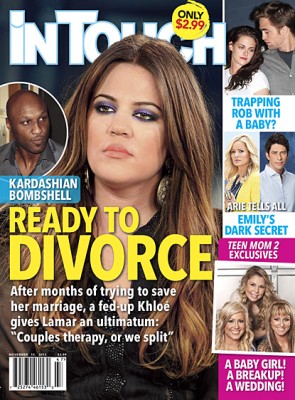
Many saw Khloe Kardashian and Lamar Odem as a great television couple. They were entertaining and had a clear adoration for one another, but this quickly changed.

About a month ago, Lamar Odem was pulled over and arrested for driving under the influence. In a matter of days, magazine headlines read “cheating scandals” and “divorce” making many fans worry that this celeb couple was falling apart.

The rumors continued to spread viciously after Lamar was accused of being a drug dealer, intouchkhloedivorcecovercheater, and horrible husband. Of course these are simply rumors, said Khloe. Despite this, Lamar recently tweeted that he is going through a dark time and that Khloe and her family have been there to support him along the way.

Lamar’s father also took to social media and then accused Khloe of being a “phony” who does not have Lamar’s best interest in mind. Once again, Lamar took to twitter and wrote, “Won’t continue 2 speak on this but I have got 2 let this out real quick. I have let this man and many others get away with a lot of sh*t. He wasn’t there 2 raise me,” Lamar vented. “He was absent ALL of my life due to his own demons. My mother and grandmother raised me. Queens raised me (FoxNews.com).”

It is clear that social media is making Lamar’s situation much more difficult than it should be. Despite his celebrity status he is human, will naturally make mistakes, and needs support from his loved ones and fans.

We can only hope that he will be on the road to recovery soon and that he will mend the relationships that have been strained by these series of unfortunate events.

Citations, accuracy, and credibility

By VALERIA VIERA

Expert witness William Gulya talks about citations and credibility in journalism on the Experts.com website at http://www.experts.com/Articles.

Gulya defines citations as an “abbreviated alphanumeric expression embedded in the body of an intellectual work that denotes an entry in the bibliographic references section of the work for the purpose of acknowledging the relevance of the works of others to the topic of discussion at the spot where the citation appears.”

And citations, of course, are at the heart of sourcing for journalists. We call it attribution. Gulya explains the important of accuracy in the stories we write, since our words should always be completely truthful, supported by sources and by the right evidence.

“Whether you have been an expert witness for years or are just starting out, accurate research, proper formatting of citations and clarity will make your written report accurate, impressive and, most of all, credible,” Gulya wrote, also explaining that making improper citations is a “critical error” which can lead to future complications.

Writing unreliable stories will provoke a loss of credibility from the audience. This is something we as journalists want to avoid, because losing credibility means what we write is not going to be taken seriously; not now, or in a close future.

Gulya also talks about stating facts and opinions, explaining that facts are objective, they are statements which can be proven. He also defines them as “something that can be verified and backed up with evidence.”

On the other hand he says opinions are subjective statements which express a certain preference or bias, and that they are basically based on a certain belief or point of view. He says opinions, on the contrary of facts,  are “not based on evidence that can be verified.” His advice is to always revise, check and cite your reference and source correctly when stating a fact or opinion.

I believe all of this information has to be taken seriously into account and we should definitely take notes from it, because what makes a journalist a good one is being able to present the information as clear as possible to his or her readers, using honesty as the first principle.

Timing, impact, prominence, proximity, human interest and novelty, all are part of the main factors that make a story newsworthy. But the element that will complete the story will always be good evidence and reliable sources to support the words written, in other words, to provide honesty to the story.

Journalism will survive the Digital Age

By MELANIE MARTINEZ

As the world constantly changes, as do technology and society, and the press has had to adapt to these changes that have taken place throughout history.

Whether it was the invention of the telegraph or advanced presses, environmental upheaval such as war, or governmental and societal pressures, history has illustrated the world’s constant state of change. The media has always played a prevalent role in all parts of society, and these changes have affected it. But rather than die out or become extinct, the craft of journalism has altered and modified itself to fit the fluctuating times.

And the future holds no exception.

Whenever I tell others that I’m a journalism major, a look of concern and pity washes over their faces.

“Are you sure about that sweetie?” they say. “You know, journalism is a dying career nowadays.”

Those who make these comments view journalism through a keyhole. They see journalism as strictly meaning the production of newspapers and – who reads the news anymore? Everything’s online, right?

Right! But you shouldn’t have doubted journalism’s ability to mold and change and grow alongside a society that is becoming increasingly digital.

George Brock, former managing editor of The Times and current head of the Department of Journalism at City University in London, wrote a book (officially published Sept. 28 of this year) titled Out of Print: Newspapers, Journalism and the Business of News in the Digital Age. 

In it, he says that “journalism is being adapted, rethought and reconstructed in thousands of ways….”

And he lists reasons journalism will adapt to survive in the Digital Age.

One is the natural fact that people like to read words from paper. And luckily, the Internet harbors potential business models for all readable platforms — magazines, newspapers, and books.  Daily newspapers have been affected because the Internet produces information in real-time, but magazines and books still remain a valued source to readers.

Which leads to the second reason — humans are creatures of habit. Those who read the news will still read the news. Newspapers have lost prevalence and may still continue to lose it but complete extinction seems rare. Avid newspaper readers will be more likely to choose website and apps that best mimic the newspaper layout, and it turns out that newspaper readers are also enthusiastic about the newspapers’ online versions.

Brock explains, “The DNA of printed journalism will altar over time, but at a slow and evolutionary pace…. News publishers must adapt their strategies to the temperament of the audience they have or they want, because members of their audience can switch so easily.”

Another reason is the fact that yes, the Internet is quick to post and comment, but newspapers – whether printed or online – know where the story is. They specialize in catering to specific interests and pointing out different details that gets the public listening.

Also catering to readers is journalism’s ability to sift through the heavy flow of information that pours out from online and organizing it in a way that is easy and accessible.

“The world’s information flow creates a demand: it is up to journalism to supply it,” writes Brock.

Perhaps Brock’s most exemplary reason that journalism will survive and evolve is its many existing precedents of already doing so, as I spoke of earlier. Journalism has renewed itself countless times, and Brock asserts that “journalism cannot survive without adapting again.”

As long as publishers and journalists understand that their work can be redesigned and modified, journalism will continue to change along with our ever-changing world.

This information from George Brock was taken from an article on www.pressgazette.co.uk, which excerpted Brock’s book.

To read the full article visit http://www.pressgazette.co.uk/content/george-brock-why-im-optmistic-journalism-will-adapt-survive-challenges-21st-century or pick up Brock’s book, Out of Print: Newspapers, Journalism, and the Business of News in the Digital Age.

Hashtags: Not just source of comic relief

By MARISSA YOUNG

Multiple people have shared the following video on my Facebook news feed: http://gizmodo.com/justin-timberlake-show-us-how-dumb-we-sound-when-we-use-1382465357.  In it, entertainers Jimmy Fallon and Justin Timberlake verbally imitate the way some people haphazardly use hashtags on social media.

HOW ANNOYING. That’s directed to my few Facebook friends who post pictures (every minute, too) with captions in which *every* one of 30 words #has #its #own #individual #hashtag. I’m not sure if they’re doing this to maximize the number of likes their photos will get, if they genuinely think people are searching for pronouns like “I” or phrases like “realwomenlikeracecars,” or if they’ve gone altogether crazy.

People like that are taking hashtags too far.  They are giving hashtags a bad rap.

I wouldn’t be so quick to cast the hashtag aside, though.  It does have its merits.  The idea behind hashtags is that social media users can search for them or click through to them in order to find related material containing the same hashtag.

This can be useful if one day you really feel like seeing posts about a certain topic, such as #cute pictures of #dogs.  This isn’t their only function: hashtags can be useful on a deeper level, too.  When news is breaking, you can click on a trending topic and view all posts with the same tag, which can help you piece together information. The posts will be from a variety of sources that can include both professional news sources and citizen journalists.  This allows you to get multiple perspectives and you can judge for yourself whether or not the posts are reliable or enlightening.

Hashtags can also benefit journalists or companies by popularizing stories or products.  This often happens with TV shows, which may present viewers with a hashtag suggestion on the bottom of their screens.  When many people use the same hashtag at the same time, the hashtag can appear under “Trends” on Twitter.

This can start conversations with people who have used the same hashtags and therefore have similar interests, like watching the same show. It may spark the curiosity of other Twitter users, who might be interested in shows or products they see on the website and decide to find out more about them. If a journalist is lucky or is good at promoting, his or her story can become a trending topic as well.

Trending topics are a good way to find out what is going on in general.  Once you get the gist of a piece of news, you can choose to pursue the rest of the story.

Even though I didn’t click on a hashtag, I came across the above video via another form of trending, as it has gone viral on social media. This just reinforces the utility of hashtags, regardless of how easy they might be to satirize.

The line between right and wrong

By DANIELA LONGO

A few weeks ago, United States commemorated the terrorist attacks of Sept. 11, 2001. Every year, the minds of the world remember that day as one of the most horrible tragedies that happened to this country.

The job of a journalist is to communicate accurately the major events that impact society on one way or another. No matter what is the story, a journalist must find the most effective and objective way to report it.

In an utopian world, people won’t have to deal with the sour moments of life. However, this is impossible and mankind must be prepared to face difficult moments.

Usually, in the moments of a collective tragedy two things can happen. A country breaks apart and doesn’t recover from it or people form an union to overcome the situation.

In the case of the 9/11, the whole country briefly shut down and the people formed a union to overcome the tragedy.

Because of this, journalists must be prepared to deal with tragedies and know how to transmit the real facts, without causing more tension in moments of panic. We saw the need for this again in Washington, D.C., and in Nairobi, Kenya, in recent days.

Media have such power that it can harm an individual or an entire society just by publishing the wrong picture.

In addition, information travels so fast that it seems a phenomenon of ubiquity.  Now information is everywhere.

This is a demonstration of the enormous responsibility that the news media carry on their shoulders.

In a world of diversity, the ethics have created a path that journalists can use to guide themselves in the decision of publishing graphic pictures or even strong language.

Each news organization has its own journalistic values and it will have different reasons to decide whether to publish a graphic picture or not. And the profession itself has set its standards through codes of professional standards and ethics.

The Miami Herald will have a different perspective on a graphic picture than the Sun Sentinel.

It is also important to evaluate the news value of a picture, because people depend on what journalist report and how they document reality.

Journalists are also human beings and they act differently under varying influences. However, when it comes the time to decide whether to publish a picture of a person, for example, falling from the World Trade Center, the decision must be based on the person’s own guidelines as well as our professional values and the decision should be free from outside influences.

In contrast, it could be argued that a strong graphic picture might attract a great quantity of viewers. However, ethically speaking, journalists should minimize harm at all cost.

Some of the things that get published can have a negative effect on some individuals. People can be harmed by what they see, even more when they deal with death, pain and traumas.

This is an endless topic. Communication is a human act, and therefore it cannot admit perfection. This means that the most thoughtful story will be submitted under the judgment of the masses. For obvious reasons, the judgment can’t be unanimous.

Some people will acclaim a publication, and there will be others who will critically disapprove the same exact publication.

Only one thing is for sure, you can’t please everyone. Act responsibly and thoughtfully.

Does unbiased journalism exist?

By REBECCA COHEN

Americans have argued for decades that the news has liberal bias, and for decades, news organizations have denied such allegations. Journalism is, by nature and definition, free of bias. It strives for objectivity. But among all of these allegations must lay a grain of truth. Could the reporting of facts be a lost art?

Groups like the Media Research Center in Reston, Va., exists to “neutralize” the alleged bias in national news media.

Its mission statement says “The Media Research Center’s unwavering commitment to neutralizing left-wing bias in the news media and popular culture has influenced how millions of Americans perceive so-called objective reporting.”

In recent news, unsupportive reports followed Republican Sen. Ted Cruz’s faux-filibuster against ObamaCare Wednesday. While journalists did not generally praise the actions of Cruz, the filibuster by Democratic Sen. Wendy Davis on abortion in June, was nearly applauded. Why?

The Washington Examiner’s Timothy P. Carney offered an explanation. “The media generally supports legalized abortion, while the media generally likes ObamaCare.”

Although this honest explanation generally makes sense, it serves as no excuse to insert opinions into reporting, because biased reporting cannot be classified as news.

However, it seems Americans are disenchanted with the honest reporting of facts, because poor explanations like the Washington Examiner’s lead the public to believe that the news should tell them what they want to hear – and if it doesn’t, they’ll turn to a source that will, the Internet.

Perhaps this alleged left-leaning media is in response to the increase of Americans getting their news information online. In a study reported by Right Side News, it is said that an estimated 84 percent of Americans get their news information online. This number has reportedly nearly doubled in the past five years.

How can a traditional, rule-following news channel keep up with the cunning and expeditious Internet?

Perhaps with bias, it can.