NFL ready for openly gay player?

By ADRIENNE MOTLEY

Recently Michael Sam, a former defensive end for the University of Missouri has admitted to being gay. This year, Sam was named SEC co-Defensive Player of the Year, first team all-SEC selection and a first team All-American by the Walter Camp Football Foundation. Analysts noted that if he were to get signed by a NFL team, he would be the first NFL player to be openly gay.

The question is, is the NFL ready for an openly gay football player. Are players and coaches going to treat him the same and with the same respect as they do “straight” players?

Sam admits that his teammates knew of his sexuality in August, and neither of them have said anything. I think this shows a great respect to his teammates, that they had enough respect for him not only as a teammate, but a brother not to say anything.

Of course, there is no way around it. He will, in fact, be treated differently. But I think during this day and age that anybody should be able to play a sport and have their own sexuality without it being a problem.

Coke’s ad: Controversial or strategic?

By VIVIAN BRAGA

The 2014 Super Bowl achieved a record of 111.5 million viewers, making it the most-watched event in the whole of the USA history.

During the event, Coca-Cola, just like any other company who has millions of dollars to spend in commercials that will last seconds, aired an ad with “America the Beautiful” sung in Spanish, Tagalog, Mandarin, Hindi, Hebrew, Keres, French and Arabic.

If you are an open-minded, well-cultured person, you must be asking yourself: “Why is this so controversial, what is the big deal?”

But if you are heartless and emotionless, you must be infuriated at the fact that it was sung in every language but English.

Indeed, there are many things not like about Coke, but their idea that the United States is a multi-cultured nation should definitely not be of them.

The ad became so controversial, hash tags saying #fuckcoke trending on Twitter for hours.

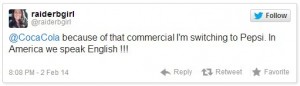
According to the media coverage post, these were the tweets considered to be “normal responses” from the average American.

tweet_01

tweet_02

But, what if it was all a marketing strategy?

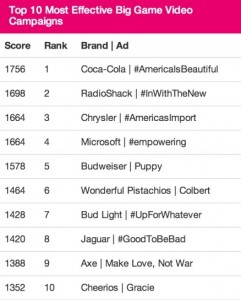
Using a weighted average of total views, subscriber growth, likeability and velocity, Touchstorm has actually worked out that the Coca-Cola ad was the most effective ad of the whole Super Bowl event.

coca_cola_table

And until today, according to E-consultancy, the Coca- Cola ad has been No. 1 for a whole consecutive week.

Whilst other brands released “sneak peaks” of their Super Bowl ad a day before its a release, Coca Cola chose not to do it.

Maybe because management feared an early revolt against it or maybe because they were just waiting for the big day. But #Americaisbeautiful ended achieving more views on its initial upload than any other ad.

So maybe the advert is not as controversial as it seems. Whilst media coverage has constantly repeating about people’s constant revolt against the ad, numbers show the message has been received more positively than what the extreme conservative politics and media has made us believe.

Do newspaper’s DUI mug shots work?

By KERRIE HECKEL

If YouTube has taught me anything, it’s that people like being in the news. And, if pretending to see a leprechaun in my neighborhood means I will get into the news, then I will tell you all about that leprechaun.

(http://www.youtube.com/watch?v=hAOQlvOeYPk)

However, in Anderson County, Ky., getting in the news seemed to lose its charm when The Anderson News printed the headline, “HAVE A HAPPY NEW YEAR. But please don’t drink and drive and risk having your picture published.”

 The small paper from Central Kentucky was introducing a new editorial piece to be picked up at the start of 1998. The editorial would publish photos of all persons convicted of drunk driving in Anderson County as an innovative way to deter driving while under the influence.

Mug shots were first published monthly, and then weekly, and then limited only those living in Anderson County or surrounding areas reached by the newspaper.

Although the newspaper’s goal to reduce drunk driving was a noble one, there was no concrete evidence the policy was helping to achieve this goal and some believed the newspaper was taking too much of a toll on residents’ personal lives.

The photos reportedly caused teasing directed towards the kids of parents with their pictures in the newspaper and even an attempted suicide of one teenager who feared having his picture published.

The Anderson News stopped publishing mug shots of drunk drivers in 2008 under a new editor and the rational that it “adds a level of punishment, or at least embarrassment, beyond what is imposed by a judge.”

What makes The Anderson News’ content interesting is that starting and stopping publishing mug shots of drunk drivers has to do with issue of morality not legality.

Legally speaking, the newspaper had every right to publish the mug shots. It is not uncommon to see stories on criminal cases in newspapers and by drinking and driving the residents of Anderson County gave up their right to privacy.

When The Anderson News began printing mug shots they were attempting to serve their public interest of keeping the streets safe. They were reporting the truth, it was relevant to the community, and using their power of voice to prevent drunk driving appeared to be a morally correct choice.

What the newspaper learned after publishing mug shots for some time was that they may be inflicting harm to their community that was not outweighed by the benefits of their drunk driving coverage. As the coverage led to teasing in schools, embarrassment among community members and, perhaps at its worst, a teenager’s attempted suicide. Analyzing these effects are what motivated the newspaper to pull the piece from their paper.

The Anderson News drunk driving coverage reminds us that being a journalist isn’t solely about circulating information. A good journalist needs to be able to understand the authority that comes with their position and how they can best serve their community.

Journalists must remember that just because something falls in the legal realm of possibility does not mean it is acceptable to publish it.

Lastly, an important point to note is that when The Anderson News pulled its drunk driving coverage, it was under a new editor. This makes me wonder if the newspaper’s employees had seen the moral issues with printing the names and images before the regular feature was pulled, but did not voice their opinions to their editor. If so, this brings up another point that journalists need to not only have a moral compass, but that they need to also be brave enough to stand up for what their gut is telling them.

A multimillion-dollar media holiday

By NICOLE LOPEZ-ALVAR

When most people think of Valentine’s Day, the images that come to mind are chocolates, flowers, cards, and candlelit dinners—all manufactured images by advertisers and media companies that have perfected their techniques of triggering viewers’ tear ducts into consumerism. Once the holiday approaches, people are compelled to be suddenly generous and search for the ideal gift for loved ones, and it comes at a price.

The average person spends about $130 on Valentine’s Day each year, with men spending roughly double the amount of women. “The average man plans to shell out $135.35 to impress the people in his life while women only expect to spend $72.28,” stated a survey.

Advertisements continuously promote manufactured love—filled with clichéd greeting cards and abundant heart-shaped chocolates. Many people feel obligated by these unrealistic expectations portrayed through media to buy gifts, reserve dinners at fancy restaurants, and send Valentine cards to loved ones out of pure obligation to this mainstream holiday.

The Greeting Card Association states that about 190 million Valentine’s Day cards are sent each year, and that does not include the millions of cards exchanged by kids as well.

Furthermore, it is the most prosperous holiday for florists, with about 224 million roses grown every year before February. Data shows that 64 percent of men and 36 percent of women buy flowers for Valentine’s Day, according to the IPOS-Insight Floral Trends Consumer Tracking Study.

These costly expectations directly and indirectly affect relationships as well.

About six million people anticipate or plan a marriage proposal on Feb. 14 every year, creating a stigma that pressures many couples into making major decisions on a deadline. Coincidently, condom sales rapidly increase right before the holiday. According to the Indo-Asian News Service, “sales of condoms increase up to 20 percent during Valentine’s week,” which coincides with the supposed $15 million spent on infertility and pregnancy tests the following weeks after, according to The Nielsen Company.

All expenses aside, the holiday’s significance in American culture, and in cultures around the world, is founded in the precious nature of relationships—whether with a significant other, family, friends, or even colleagues and classmates.  While mainstream media have created a multimillion-dollar industry out of the holiday, Valentine’s Day is a reminder to make sure the people who mean the most in your life know they are loved. Maybe advertisers and corporations do have the right idea, after all.

Risk gene tied to Olympic athletes?

By CLARA BENDAYAN

With the Olympic Winter Games well under way, it seems fitting to draw comparisons with its counterpart: the Olympic Summer Games.

While the summer games boast more athletes and a greater variety of events, the winter games exhibit an uncanny amount of risk-taking.

We watch 15-year-olds being thrown feet off the ice and perform pirouettes in the air, all while placing their safety in their partners hands.

Our jaws drop as we watch 17-year-olds ski 90 miles an hour down a steep hill that spans more than four football fields in length.

Our knuckles clench and turn white as we anxiously grip the edges of our seats while watching 26-year-olds rocket down icy sheets with their faces just mere inches from the solid surface.

While watching, most people are thinking something along the lines of “Are these people crazy?” Or “I would never be able to do that.”

The risks these athletes take on a daily basis are monumental and can be fatal in many cases.

Is this need for speed inherent? Former alpine ski racer, Todd Brooker seems to think so. He thinks “it’s just part of your life. It’s something you’re born with.”

In fact, he may actually be onto something.

For the past two decades, scientists have known of the existence of a risk gene, and they say that one in five of us possess the genetic marker.

Steve Perino, the ski reporter for NBC at the Sochi games, mentioned speed addiction in his coverage. Science supports this phenomenon by claiming that it is based on the chemical reaction that this type of risk taking behavior produces in the brain.

It would seem to make sense that something ingrained in our biological makeup would be the force behind some people’s complete lack of fear when it comes to performing tasks that most humans wouldn’t dare try.

Dr. Nancy Snyderman, a physician who covers health and medicine for NBC, said, “There’s a reason why some of us are spectators and others are Formula One drivers.”

How else can it be explained that some people perform death-defying acrobatics on a sharply inclined snowy hill that’s more than 30 stories tall, while others can’t even jump off a diving board that’s four feet off the ground?

In my opinion, it seems to make sense that there is a scientific reason as to why many of us are spectators, while a select few of us are in Sochi right now skiing down steep hills at over 80 mph. However, it also makes me think about how it will affect the games in an ethical way if people begin to get tested for such a gene.

The brilliance of the Olympics is watching teenagers and adults alike performing acts that many of us will never come close to executing. It’s seeing how they grew up miles or continents away from us and one day decided to pick up a snowboard when they were toddlers.

There’s an outpouring of heartfelt stories where we see athletes as two-year-olds diving into a pool for the first time, realizing they had a love for the water and then watching them stand on the podium with a gold medal in hand years later — proud of themselves, their determination, their hard work, and most importantly confident in their choice of pursuing these sports.

If people are able to test themselves for the gene, what’s going to happen if the only Olympians we see are those who tested positively and use that fact as their sole motivation? Will we still admire their courageousness and passion?

While very interesting, I believe that this gene may rid the Olympic Games of its very essence — becoming an athlete based on passion, love and dedication to the sport. Because you believe that you are capable of defying odds and taking risks. Not because some machine confirmed that you’re genetically made for something greater.

So what’s the final verdict? Can this extraordinary defiance of fear be founded upon science? Are Olympians destined to become risk-takers from birth? Is there a concrete, scientific reason that explains why we don’t all become Olympians? And most importantly, what will happen to the Olympics if people begin to test themselves for the risk gene?
Snow days can still require school work

By KYLA THORPE

It seems that nearly everywhere in America there are intense winter storms, shutting down schools and giving students a break from classes.

Or so they would hope.

Just a couple of decades, even years, ago, when all schoolwork was strictly in the classroom, a snow day meant staying in bed and maybe spending some extra time with the family.

In the era that we live in now, just about all of our schoolwork is regularly online, whether it’s homework, PowerPoint slides, or necessary readings.

While many stressed out students would love to just relax for a day or two and catch up on some work, their professors and teachers alike continue to give them assignments online.

It seems to be a growing phenomenon as more news media sites are reporting this trend and more students are complaining. I find the complaints appropriate, though.

Being from Florida, I’m used to not having school due to bad weather, too, but it is usually from tropical storms such as hurricanes.

While there was always a threat of danger and the power going out, these days were great for catching up on sleep and possibly getting ahead in work.

Now, I worry that if we get another hurricane day, I’ll still be stressed out doing work.

Another thing to consider with this situation is with all the work being posted online, what about the students who are located in an area where the power does go out?

Is there a way that they can produce a document that they were truly unable to do any work online without an Internet connection to begin with?

I feel like this solution that schools are using will work for a little while but will have many complications arise soon.

I’m aware that some schools find it to be necessary.

When Hurricane Sandy happened, for example, schools that had to be shut down petitioned for an official “virtual,” school day so that they wouldn’t go over the three snow days already given and have to add school days to a future vacation day.

This is an instance where a virtual school day seems great.

Still though, being in college, there have been moments where I have wished for a snow day so I can have a moment to recharge.

Maybe I shouldn’t wish for those kinds of days anymore, since snow days aren’t necessarily fun days anymore.

It’ll be interesting to see how this all turns out and to see how students take to it.

Airline’s video: Offensive? Entertaining?

By SOFIA ORTEGA

Every time a flight is about to take off, the airline rolls a safety video for passengers. Yet, very often many get distracted and do not watch it.

For this reason, Air New Zealand partnered with the magazine Sports Illustrated to produce the video “Safety in Paradise.” The video was filmed in the Cook Islands, and shows models explaining all safety procedures in case of an emergency.

Air New Zealand debuted the video this Tuesday and will begin to play it in all of its flights commencing at the end of February.

However, what was thought to bring entertainment and work as an attention getter for passengers to prepare in case of an emergency; caught the attention of many in a negatively.

The video unraveled controversy because it showed women with few clothe on. But, isn’t it normal to show women in swimsuits if they are in the beach?

If people get offended because of the bikini, probably New Zealand is not the right destination for these people since they will surely find women in bikini.

Some have praised the company for the marketing strategies, but others have criticized it.

Sexist … malnourished models … not really showing the true beauty of the Cook Islands?

“It seems that suddenly they are saying that my sexuality is all that matters about me,”  Deborah Russell, professor at Massey University, said to the Sydney Morning Herald.

A video showing several models at the beach does not make the company sexist and it does not mean that Air New Zealand is trying to say how women should be or look like. Contrarily, the company depicts the beauty of the Island and its people. And the video has surely attracted plenty of news media attention.

Some people may approve and others disapprove the video, but certainly the company accomplished its goal: to get people to pay attention to the safety video.

The video has gone viral in YouTube reaching more than six million views in less than one week.

In my opinion, Air New Zealand has done a great job with the safety video. It is a creative way of displaying important information that will surely get the attention of passengers.

Sexual orientation knocks on NFL door

By JOHN RIOUX

Earlier this week, former Missouri football player Michael Sam announced in an interview with The New York Times that he is gay.

While the progressive point of view is this should be no news at all, the reality of the situation is there has never been an openly gay player in any major American sport.

I would be more than thrilled if this had no affect on Sam’s upcoming NFL Draft stock, however, that will not be the case.

The NFL has always been the American sport to hold the “macho” title. They are known as the guys who play through concussions and broken bones, so there was no way a gay man could suit up, right?

The various owners and general managers who believe these ignorant stereotypes need a reality check. There will be those who say he will be a distraction because of the media attention, but that will be out of the way after the first week of training camp.

It is important that journalists continue their support of Sam to pressure owners into researching his football talent, not his personal life.

Focus on Sam’s accolades, such as co-SEC defensive player of the year. Winners of this award since 2004 include David Pollack, Patrick Willis, Glenn Dorsey, Eric Berry, Rolando McClain, Nick Fairley, Morris Claiborne, and Jarvis Jones. Another thing these players have in common, they were all first round picks.

While I understand collegiate success does not always translate to the NFL, there are players who have actual issues related to drugs or violation of team rules. When the media examines these problems, teams use answers such as “we thought the reward outweighed the risk.”

I can tell you that also holds true here.

An anonymous source at Missouri who interacts with players on a daily basis said, “that over the season, he barely thought about Sam’s sexual orientation.”

If college students who are not yet fully matured can embrace Sam, this should be no problem for an NFL team.

The news media needs to focus on the idea that this is a game. The ESPNs of the world harp on the SEC being far and away the best conference in college football . Well, Sam was the best defensive player in the best conference of football. If that does not prove enough to move past this issue, I do not know what will.

Weather news no longer boring

By JENNA JOHNSON

The No. 1 thing people are told not to discuss if they are worried about appearing boring is…

Weather.

If you guessed correctly, congratulations. You could’ve just won a round of “Family Feud.”

Weather is generally accepted as one of the most mundane small-talk topics known to man, reserved to be spoken about only as a last resort.

However, lately weather has been the topic on everyone’s lips and on every news platform.

What causes a boring topic to catapult to the front page of every paper, lead story of television newscasts, and the home page of every news Web site?

The answer is the bizarre factor.

Winter storms in the north and northeast will be mentioned in the local paper, but won’t usually receive so much as a blurb in national news. But when a few inches of snow paralyzes the entire metropolitan area of Atlanta, the weather certainly makes headlines.

Atlanta became a classic example of Murphy’s Law when the storm hit. Traffic stopped resulting in 20-hour commutes, children were held overnight in their schools, citizens were encouraged to stay home and off the roads. The nation’s ninth largest metropolitan city, the headquarters of CNN, Coca-Cola, Home Depot, and even the Weather Channel, was unable to respond efficiently.

Reporters went wild. After all, it’s not every day that the south gets snow, and it’s not every day that a city actually shuts down over two-plus inches of it.

The problems caused by the weather were so extensive that reporters continued to follow the story after the icy situation had been resolved, analyzing who was at fault for Atlanta’s inefficient emergency response system.  The buzz created even extended into this week. Reporters Wednesday wrote stories spectating on Atlanta’s reaction to another incoming storm before it even hit.

Though this week’s storm was more severe than the one prior, it appears Atlanta learned its lesson from the “Snow-pocolypse.” People have been staying off the roads and government buildings and schools were closed well in advance to avoid the traffic.

Whether the weather-obsessed reporters had to anything to do with Atlanta’s much cleaner response to storm number two is up for interpretation. My guess is that Atlanta didn’t want to be the recipient of northern ridicule again.

Michael Sam and the media

By RYAN HENSELER

Earlier this week, former Missouri defensive end and NFL prospect Michael Sam came out as gay, and will likely become the first openly gay NFL player following the draft in April.

Since Sam’s announcement, the news media, especially ESPN, has covered the story non-stop. Articles on Sam have filled the pages of ESPN.com, stories about him have been covered by Sportscenter, and his NFL draft stock has been constantly analyzed.

However, while most media sources have been highly supportive of Sam, the question remains; are they really doing him any favors by constantly featuring the story? Or are they actually hurting the cause of the player that they claim to embrace?

Since Sam has come out, certain NFL executives that wished to remain anonymous have stated that his draft stock will likely fall following the revelation. Some would say that this only reinforces the macho, misogynist stereotype of the NFL.

However, most teams that pass on Sam in the draft will not do so out of hatred or homophobia, but a desire to avoid the media circus that will inevitably follow Sam throughout the season.

NFL teams are well known for trying to avoid “distractions” at all costs. Any type of story that attracts severe media coverage is seen as a threat to the team’s on-field performance.

A recent example that exemplifies this idea is the ongoing saga of former Miami Dolphins players Richie Incognito and Jonathan Martin. When the story first broke of alleged bullying in the locker room, the team was above .500 and contending for the playoffs.

After the story made national headlines and became a “distraction” to players, the Dolphins lost their last two games to division rivals New York and Buffalo and missed the playoffs.

The point is, networks such as ESPN claim to be fully behind Michael Sam, but constantly adding to the story will only reinforce the idea in executives’ minds that having Sam on their team could potentially cause a distraction in the locker room that could manifest itself on the football field.

If the news media really want to help Michael Sam succeed as a professional, they should limit their coverage of the story and allow him to be seen first and foremost as a very, very good football player with NFL talent who happens to be gay, rather than simply the gay player.

Sports equality: Gay athletes in sports

By KELLY BRODY

It seems as though we are living in the “Age of Equality.” Gay marriage is being passed in many new states and countries, and more and more celebrities are embracing a “don’t hide who you truly are” attitude.

It’s cool now to be out of the closet and most of the world, in this progressive Age of Equality, is accepting of those who choose to announce to the world their sexual orientation.Yet while Hollywood has embraced ‘coming out,’ one sector of pop culture seems to be still hidden deep in the closet and less accepting of gays — the world of sports.

Seen as a testament to one’s manhood that dates back to the testosterone-heavy first-ever Olympic Games, sports are often a sign of heterosexuality. It’s a common misunderstanding that a boy involved in sports can’t be gay, which is why many parents suspecting of the sexual orientation of their sons feel that the “cure” is sports like football.

With the recent announcement of Micheal Sam, a young NFL prospect hailing from the University of Missouri who came out as gay, the sporting world has been in shock. Not often does a football player shed his macho image and come forward about his sexual orientation. He stated, “I am an openly proud gay man,” in a New York Times piece, but his teammates have known since August. If Sam is drafted and earns a spot on a team roster, he will be the first openly gay player in the NFL.

Still, eight NFL staff and coaches that were polled by Sports Illustrated believe that Sam will drop in the draft due to his announcement. Backlash isn’t uncommon for gay athletes. Tweets often contained strong language. Two examples: “So, message to Michael Sam and those like him: Nobody wants to hear about a man who likes to suck cock. Get back in the fucking closet” (@icanhasbailout) and “Michael Sam first openly gay athlete in the NFL??? that’s freaking disgusting!!!!!! should be kicked out if the NFL and the USA” (greyclark24).

Sam’s announcement is coming off the heels of British diver Tom Daley’s coming out, which he did via a YouTube video a few months ago. The Olympian was shown massive support, which could be due to the fact that diving is seen as a “gay” sport versus the masculinity of football. Another sport that is often labelled as “gay” is men’s figure skating. Still, American men’s figure skaters are encouraged to not announce their sexual orientation for the purpose of appealing to the American public and judges.

This fear of being gay in sports is something that should not exist in the coming years. Sexual orientation does not change the athleticism of great athletes, nor does it diminish their accomplishments. For this year’s Olympics in Sochi, where being a gay athlete is abhorred, the world’s athletes responded with the utmost support for LGBTQ rights. Germany walked in the opening ceremony wearing rainbow snowsuits, Greece’s athletes had rainbow fingertips on their gloves, and Blake Skejellerup, an openly gay New Zealand speed skater, wore a rainbow pin.

With the bravery of both Michael Sam and Tom Daley, hopefully more athletes will feel safe coming out of the closet and the Sochi Olympics will open the eyes of the world, especially Russia, that discrimination of gay athletes is not something to be tolerated in our ever evolving world.

Sochi not ready, but games begin

By NICK CARRA

The opening ceremonies for the Winter Olympic Games began at 11 a.m last Friday and reports from journalists about the conditions of the host city Sochi, Russia, are are not looking good.

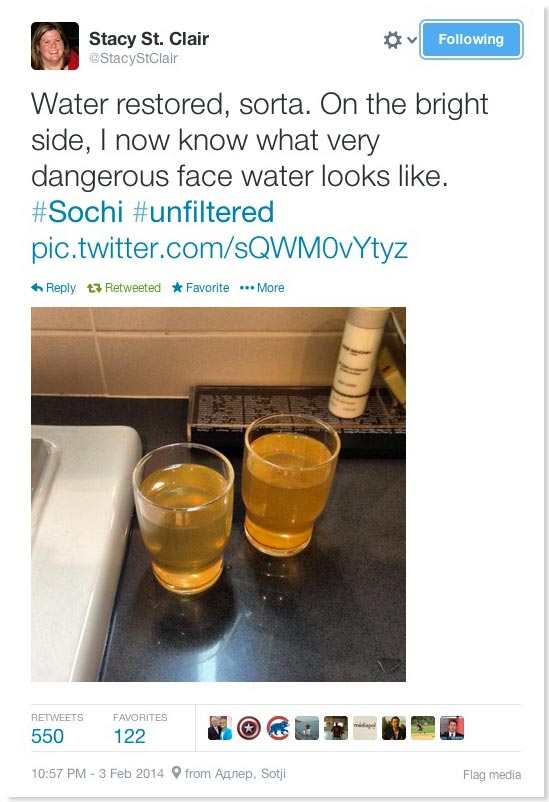
Hotels are in shambles. Reporters and athletes live in rooms that would disgust me with their colorless, broken-down walls and filthy bathrooms.  The locks on doors do not work, plumbing is not fully functional, water looks like warm beer and curtains and walls are torn apart.

A reporter tweeted a picture of two glasses of water from Sochi, Russia.  Hotels advised residents to avoid the water because it was "dangerous."

A reporter tweeted a picture of two glasses of water from Sochi, Russia.  Hotels advised residents to avoid the water because it was “dangerous.”

From what it looks like, Sochi isn’t ready to host the Winter Olympic Games. Do an image search for “Sochi Olympic hotel conditions.” Inside you will find pictures of toilets placed feet away from each other without privacy, blank walls and malfunctioning electricity.

Even the slope-style snowboarding course was inadequate.

Employees were seen hours before Friday’s events working on the slope-style course, athletes say the snow conditions aren’t good and some have even been injured during the practice runs.

Marika Enne of Finland was carried off in a stretcher, after hitting her head during the slope-style practice run.  U.S athlete Shaun White jammed his wrist during the practice as well.

White withdrew from the event, although his main focus is to win the half-pipe, he would also like to avoid injury.

“With the practice runs I have taken, even after course modifications and watching fellow athletes get hurt, the potential risk of injury is a bit too much for me to gamble my other Olympics goals on,” White said regarding his withdrawal.

During the opening ceremony, the fifth ring in the Olympic symbol failed to illuminate, which furthers the thought that Sochi just may have too much on their hands to handle the Olympic games.  From what it looks like, those in Russia failed to prepare the city of Sochi for the 2014 Winter Olympics.

Time crunches and fact checking

By KERRIE HECKEL

When the two bombs at the Boston Marathon went off on April 15, 2013, I was sitting in a class at my former high school, nearly 3,000 miles away. In less than half an hour, I found out about the bombing. Not from a teacher or announcement, nor a radio or television, but through a tweet sent out by CNN.

While only 8 percent of Americans use Twitter to receive news today, according to Pew research, that number is growing.

Part of the appeal is that Twitter and other online resources alike make circulating news faster now than it has ever been.

The beauty of a tweet is that journalists that have Twitter accounts can write and share a breaking story in seconds. Some will even send out a tweet directly after an interview.

Then to lessen the time frame between a journalist receiving knowledge and forwarding it to us is the matter of smartphones.

Anyone who carries a smartphone has access to these tweets in the literal palm of their hand. And it seems everyone today has a smartphone.

Business Insider estimated that about 22 percent of people in the world would own a smartphone by the end of 2013. Considering areas of the world where technology like this still isn’t available, it is reasonable to believe that if we looked only at Americans the percentage would be higher. Of course, if you’d like to see for yourself you could always glance around a college campus and try to count the number of students walking, smart phone in hand.

Simply enough, Twitter and others alike have made fast paced reporting something we’ve become accustomed to.

More and more immediacy from our news sources is something many of us expect. So, it’s no wonder why many reporters and news organizations make getting a story out quickly a top priority.

And while circulating information quickly may be important, one wonders what we lose when journalists spend less time with their stories.

According to Pew research, 75 percent of Americans don’t think journalists get their facts straight. Could this be an effect of rushed reporting?

The fact of the matter is when reporters are competing with one another to get the information out first; fact checking can take somewhat of a back seat.

This isn’t all speculation; in 2012, The New York Times asked in an Internet survey if reporters should fact check what politicians say. This question, I think brought to many peoples’ attention that fact that fact checking is no longer as important as it once was.

Many people took offense to the question and The Times received a number of sarcastic answers asking if they were joking.

What many reporters and readers may not consider is that there is a trade off between speed and fact checking. The faster a story breaks the less time was spent fact checking, where a story that may take longer to publish allows the journalist more time to fact check. This inverse relation means reporting a story quickly and thoroughly is a feat for any journalist.

However if many people are demanding both, just what exactly are journalists to do?

Credibility issues grow with gossip

By CLARA BENDAYAN

The evolution and progression of social media have paved the path for novel ways to share news.

News sources are no longer limited to articles on websites or television programs. Outlets such as Twitter, Facebook and Tumblr have become sources for people to check the goings on around the world.

While it’s very convenient to be able to scroll through a Twitter feed and receive news, it isn’t always the most reliable way to secure accurate details. Twitter is a conversational, flow of thoughts type of outlet. People generate countless tweets in minutes, each reporting further details as more information is discovered and facts can be disproved within seconds. Another issue is the source of the news. Different news outlets inevitably stand out as more verifiable than others based on past credibility as well as the type of news they’re associated with.

A tweet from a reporter at CNN or Huffington Post is likely to be a very accurate source when seeking error-free and immediate news. Although some major news outlets provided some false information in the wake of the Boston Marathon bombing last April, this can be attributed to the mere fact that reporting at an instant amid such a chaotic event prioritizes fast news rather than deliberate research to verify all facts.

Contrastingly, news outlets known for celebrity gossip such as TMZ come into question when searching for reliable news. When actor Paul Walker tragically died suddenly in a car accident last November, many celebrity gossip outlets immediately sent out a slew of tweets announcing his death. Facts were stated then retracted, later restated and retracted once again. False information was released as the article was published amidst the investigation, while many facts were still unknown. Many people tweeted that they refused to believe the news until a more reputable source confirmed it. Sure enough, after news sources such as The Los Angeles Times and The Huffington Post confirmed it, people began to send their condolences via Twitter and Facebook. Many people also went on to criticize and point out the multitude of inconsistencies present in the TMZ story after reading the complete, factual account from other more credible news outlets.

The same situation occurred this past week with the recent unexpected death of Philip Seymour Hoffman. Drug-related deaths tend to be very sudden and unanticipated, and people don’t accept the facts until they see confirmation on reputable news sources and televised news programs. In this case, TMZ was among the first news outlets to break the tragic story. Many people refused to believe it as there were rumors of a death hoax surrounding Hoffman before his actual passing. A while after TMZ broke the story people finally began to accept the news when The Wall Street Journal tweeted confirmation.

A journalist’s credibility is of utmost importance as no publication or outlet wants to be associated with a reporter whose credibility comes into question. Aside from TMZ, there are countless websites that report mainly gossip or focus on entertainment news rather than hard news. With the Internet, the line between what is real and what is a hoax has become incredibly hazy. Many news websites don’t pride themselves on accuracy and focus instead on delivering scandalous news that will appeal to readers.

Magazines such as Ok! and Star sell out on stands because people want to indulge in some quick gossip. However, when it comes to seeking out serious news people want nothing to do with them.

So, while we enjoy indulging in our guilty pleasures and reading celebrity gossip, perhaps their topics of coverage have garnered them an unfortunate position of incredibility when it comes to reporting serious news. While social media sites have been vital in advancing the way in which reporters deliver immediate news, they have also been instrumental in exposing people to the fact that news may not always be verifiable and not all sources can or should be trusted blindly. Should TMZ strictly stick to reporting the whereabouts and affairs of Hollywood’s starlets and leave the serious work for CNN, The Wall Street Journal and the like? Many people seem to think it best.

Writing with a national perspective

By NICOLE HOOD

I recently read a CNN article on the preliminary session of the Syrian peace talks, in which a peculiar event took place — Iran was invited to the conference and then dis-invited by UN chief Ban Ki-moon.

The reporters went on to say that ‘Western leaders believe Iran has provided military and intelligence support to Syrian government forces,’ and that fighters from Iran-backed militia have fought on the side of the Syrian government. When I first read this, who actually dis-invited Iran was unclear to me, as was the reason that the event occurred. The succession of the reporters’ choices implies that the reason Iran did not attend/was dis-invited was for military reasons.

The reality of the situation was that the UN gave Iran an ultimatum: that Iran could attend the peace conferences on the side of the UN (against the Syrian government) or they could not attend. Iran chose not to stand against Syria, and did not attend. This was information available to my International Studies teacher but not to the reporters at the time, and they used Western leaders’ opinions as their next step in explaining the information.

Does this represent a nationalistic explanation of international events?

I think so. This nationalism, I believe, comes out naturally and is almost inescapable. The only way one could report this in an absolutely unbiased way would be to provide the audience with a transcript of the talks and let them come to their own conclusions. People generally want a summary — and all summaries are written from the view of the reporter. Most people with an interest in world news still do not want an intensive reading representing a complex and dizzying array of international relations.

That being said, the fact that our tendency towards nationalism is expressed with militaristic assumptions can be dangerous in the world of reporting—and in our own lives. To assume militaristic reasons behind anything because of a lack of information might be rationally considering all possibilities—or it might be demonization of other countries or other parts of the world that we don’t understand.

I believe that the fault lies not particularly in presenting this one personal conclusion (of many possible conclusions) but in leaving out that they could not find a definite reason to present to the audience or that it was only one conclusion of many. Had the reporters mentioned the lack of information, I (and other readers) would be less inclined to confidently believe that militaristic support was the key to figuring out what was happening.

After reading the article, that piece of information stood out most to me — and then, the next day I learned what I confidently took away from the article was wrong. Iran was not particularly hiding something military and that was not why they were dis-invited. The slightest difference in presentation of information makes a big difference.

For more information about this, go to:

http://www.cnn.com/2014/01/22/world/europe/syria-geneva-talks/index.html?hpt=wo_c1

Celebrity obsession: Is it really news?

By PHOEBE FITZ

The story of Justin Bieber’s DUI arrest was a news and entertainment media frenzy.

From newspapers to magazines, TV shows to social media, it was impossible not to be bombarded with information regarding the scandal. Why is it that the story of a teenage boy being arrested in Miami is front page news for days? How has our concept of “journalism” and “news” come to focus on what many see to be an unimportant event?

These questions have a simple answer. Bieber’s story was such big news because of the size of his following—millions and millions of tween girls. As one of the biggest pop stars on the planet, his every move is documented and analyzed, providing whoever writes about it with a plethora of internet hits or TV views.

However, does every young girl in America being in love with Bieber constitute America’s most prolific and respected news organizations to dedicate so much of their time and effort to covering the story of his arrest?

Perhaps incidents like these are a sign of changing times, of our society as a wholes’ obsession with social media and through that, celebrities. Twitter has more than 230 million active users, with 100 million of them logging in every day. The accessibility of Twitter allows many users easy access into what used to be the private world of celebrities.

Thanks to social media outlets like Twitter, it is becoming increasingly common for people to become celebrity obsessed, particularly in the case of Justin Bieber. With almost 50 million Twitter followers who are quick to defend him — in the case of his arrest — or target his potential girlfriends—actress Selena Gomez received death threats as did model Cailin Russo — Bieber’s followers are an enthusiastic bunch.

Through our obsession with social media, we are cultivating a society that is obsessed with celebrities and “celebrity news”. This category used to stand on it’s own, differentiated from regular news. Perhaps now the two are merging. Perhaps, for better or for worse, we are redefining what is truly considered “news.”

CVS switches to tobacco-free stores

By SOFIA ORTEGA

The second-largest drugstore group in the country, CVS, announced that by October the company would stop selling cigarettes and other tobacco products in all of its stores. And it has generated quite a bit of news media attention this week.

“We came to the decision that cigarettes and providing health care just don’t go together in the same setting”, stated Larry J. Merlo, CEO of CVS Caremax.

It is projected that the company will take away 17 cents in profits per share of stock a year. To make up the revenue loss, the company will start this spring a smoking termination program to help Americans get over the habit.

In 2000, the company opened MinuteClinic, the first retail medical clinics in the country, offering its service in more than 800 CVS pharmacies. As it is hoping to open 700 more by 2017, it was crucial to position CVS Caremax tobacco-free to seek the growth of the company.

ChangeLab Solutions, a nonprofit organization that offers legal evidence about public health stated that more than 400,000 American die each year due to smoking, and that unfortunately, the rate has remained stagnant over the last ten years.

But, will CVS decision help lower the smoking rate in the U.S.?

Unfortunately, most of the tobacco purchase is done in convenience stores. Therefore, CVS’s contribution to promote a tobacco-free generation will mostly mark their transition to be recognized as a health care company rather than just another drugstore.

However, the decision of a leading pharmacy chain to stop the sale of tobacco products will probably resonate in different states to independent groups as an opportunity to fight for a law that prohibit drugstores from selling these products.

Most Americans have a drugstore only five miles from home. Since studies have shown that -the more tobacco retailers, the higher smoking rates-. Prohibiting the sale of tobacco in drugstores will automatically reduce smoking rates.

A pharmacy’s goal should be to look for the health of the population; therefore, their stock should go according to the company’s goal and not obstruct it.

As President Obama said, CVS decision will help advance the “efforts to reduce tobacco- related deaths, cancer, and heart disease, as well as bring down health care costs- ultimately saving lives and protecting untold numbers of families from pain and heartbreak for years to come.”

Media focus on Russia’s anti-gay laws

By NICOLE LOPEZ-ALVAR

Friday is the official start of the 2014 Winter Olympic Games in Sochi, Russia; however, the biggest story coming out of Sochi has little to pertain to the games at all.

From the homepage of Google to the breaking headline of any online news source, there is no doubt that the media is fighting back against Russia’s anti-gay policies being enforced as the Winter Games ensue.

The law, which criminalizes any discussion of gay rights in the presence of minors, is an example of the unfortunate reality we live in — discrimination continues to persist in many parts of the world. According to the Associated Press, gay activists have been penalized across Russia ever since the law was implemented in 2013. Such a law only fuels hatred and justifies violence.

Yet, there is one global medium that has sided with civil rights — that is, the news media.

Google’s “Doodle” on its search homepage, which debuted on Thursday night, is its logo with an illustration incorporating the colors of the rainbow. It has been seen around the world, even Russia, and has sparked both cheer and outrage. Below the logo was a subtle, yet powerful, message in clear support of equality for all.

Google, a worldwide corporation, has taken a stand to publicly show support for LGBT people who are struggling for equality around the world.  According to Google’s website, “every day Google answers more than one billion questions from people around the globe in 181 countries and 146 languages.”

That is, roughly one billion people a day, whether aware so or not, will glance at that logo and be aesthetically drawn to the colors of the rainbow — the official colors of the pride flag. It is in these subtle ways that the media and many major corporations have brilliantly managed to maintain the principles in which they stand for — delivering to all the people.

Google is not alone. Three official sponsors of the U.S. Olympic Committee, Chobani, AT&T, and DeVry University, have taken public stands against the anti-gay law in Russia as well.

These positive actions have outshined the media’s coverage of the anti-gay law itself. Their public defense of the LGBT community during one of the world’s most televised events, the Winter Olympics, is an indicator of how both companies and the media can work hand-in-hand to create change in this society. These efforts that are seen, read, and heard through media outlets can influence government policies around the world.

While mainstream media does not hold the opinions of every individual, it is the one domain that can have the largest positive impact on society.

The debate on what is the “proper” media representation of the LGBT community is still ongoing, but there is not doubt that major companies’ positive actions can create a domino effect on other companies to follow suit. In this day and age, showing public support via media platforms is vital in order to effectively communicate any message, especially one of equality.

The Sherman effect in sports journalism

By RYAN HENSELER

As most know, last Sunday the Seattle Seahawks emerged as Super Bowl champions, manhandling the AFC champion Denver Broncos, 43-8. The win was largely thanks to the defense, particularly the secondary, nicknamed the Legion of Boom (L.O.B). The unit has been touted recently as one of the greatest defenses in NFL history. However, arguably the best player on that defense, CB Richard Sherman, is also undoubtedly the most controversial figure in the game today.

Sherman made national headlines due to his postgame interview following the NFC Championship game, an event in which he made a game-saving play to help the Seahawks defeat the San Fransisco 49ers. When Erin Andrews asked Sherman to analyze the final play, he forcefully yelled at the camera, “I’m the best corner in the game! When you try me with a sorry receiver like Crabtree, that’s the result you gonna get! Don’t you ever talk about me! … Don’t you ever open your mouth about the best, or Imma shut it for you real quick! L.O.B!”

Obviously, this response is not typical for a professional athlete in a post-game interview. However, it raises the question, should it be? Most players are taught by their organizations to speak to reporters in near clichés and give simple answers that are seen as more professional. For example, a more common answer to Andrews’ question would be, “I was just trying to make a play and I’m glad my teammate was able to come down with the interception. We played a great game today and the 49ers are a great team.”

Although something to that effect would be a typical answer, it is questionable whether that is all that the player would really like to say. The reason that sports in general, and the NFL in particular, are so popular and exciting to watch is the intensity and passion displayed by the players during every single play. When you think about it, it is a weird concept to ask the players to shift out of hyper-competitive mode into interview mode so soon after the game is over.

Would the game not be that much more interesting if more post-game interviews were honest and candid like Sherman’s? It would add a whole new element to the game for the fans, who are rarely really able to see the trash-talking and personal interactions between opposing players that go on between the lines.

Even Andrews herself, who many thought would be troubled by the incident, was very supportive of Sherman, saying, “I wish more athletes would be like that. We want someone to lose their minds like that.”

Although it is unlikely that most coaches, particularly old-school coaches like the New England Patriots’ Bill Belichick, will allow their players to speak this way to the media, it will be interesting to see if there are any even minor changes in the way that players handle reporters next season. If there are, and fiery interviews like Sherman’s become more commonplace, we could be seeing the start of a completely new style of sports journalism.

Should college athletes get paid?

By ADRIENNE MOTLEY

This is one of the biggest discussions involving college athletes today. The average athletic scholarship over the course of four years is valued at more than $100,000.  But the scholarship doesn’t put money in athlete’s pockets for food and clothing.

Being a student-athlete is a full time job. You have workouts or practice before classes begin, and are expected to pay attention through three and sometimes four classes in a row. Then after we have to lift weights and go to mandatory study hall. Our day starts at the crack of dawn and usually ends when it’s dark. We give up going home for holidays and summer break for competition and practices.

A student athlete gets exploited to bring money to the school by playing games. Athletes can’t earn money by signing autographs, but NCAA executives make millions of dollars. The NCAA and CBS signed a $10.8 billion television agreement over 14 years.

I believe student athletes should profit off of being a member of a collegiate athletic team. The little money we would profit would be nowhere near what executives make, but it would help us with extra expenses not detailed in an athletic scholarship.